
Consider two numbers assigned to the same ton of carbon dioxide, each claiming scientific validity. The first: a figure between $1 and $7, representing the first Trump administration’s calculation of the societal damage caused by each ton of CO₂. The second: $190, representing the Biden administration’s calculation for that identical quantity of carbon. This metric, the social cost of carbon (SCC), is a single number meant to represent the total harm—from crop losses to health problems to sea-level rise—caused by emitting one ton of carbon dioxide. It has become a central battleground in U.S. climate policy.
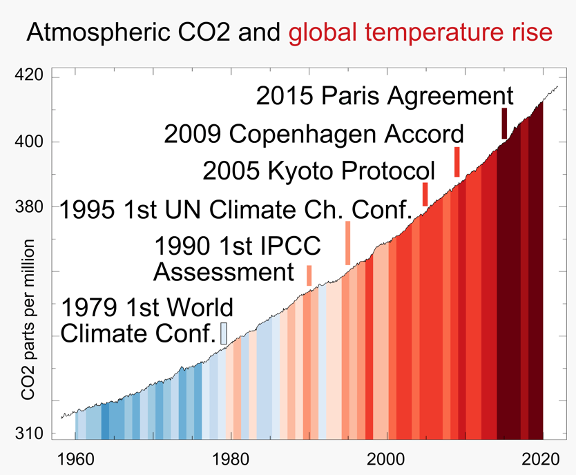
Atmospheric CO₂ has risen steadily through every major climate agreement since the 1970s. (NOAA / Ed Hawkins)
The usual explanation for this whiplash is political: one side follows science while the other ignores it. But that story misses a more fundamental problem. The first Trump administration didn’t need to deny climate science to gut the SCC—it simply exploited the metric’s built-in manipulability, using established government guidance to select assumptions that minimized the result. By changing just two parameters—the discount rate and geographic scope—the administration reduced the figure from $51 to between $1 and $7 per ton, all while remaining within methodological boundaries that practitioners recognize as legitimate.
When a tool designed to guide climate policy can swing by a factor of nearly 200 without either side departing from accepted methodological norms, the problem isn’t just politics. It’s the tool itself. As legal scholars David Adelman and Amy Sinden observe, this pattern reveals a systematic problem with cost-benefit analysis in environmental policy: when underlying value judgments are deeply contested, the methodology cannot constrain discretion—it can only disguise those judgments as technical parameters. Frank Ackerman and Lisa Heinzerling have reached the same conclusion from a different angle: some harms—the loss of a species, the flooding of a country, the welfare of people not yet born—resist meaningful translation into dollar figures, and a framework that forces that translation will distort the very decisions it claims to clarify.
The enormous variation in the economics literature provides further evidence. Credentialed economists have produced estimates ranging from less than $0 to over $2,000 per ton. A framework capable of producing such divergent results under different but equally defensible assumptions cannot provide the stable policy guidance it promises. It becomes a mechanism for translating political preferences into technical-looking numbers rather than a constraint on those preferences.
The SCC in Practice: A Tool of Institutional Convenience
The social cost of carbon (SCC) emerged from an intuitive premise. For decades, regulatory agencies have used cost-benefit analysis (CBA), a framework for weighing the projected costs and benefits of proposed rules. To make climate policy fit this familiar process, experts sought to quantify and monetize the damages from carbon emissions. This would allow agencies to incorporate climate impacts into their calculations, theoretically grounding decisions in objective economic analysis. To pursue this goal, the Obama administration established an Interagency Working Group (a panel of agency economists) that produced an estimate of approximately $42 per ton (roughly $51 in today’s dollars), presented as the product of rigorous, peer-reviewed analysis.
What followed questioned the precision of the presentation. The first Trump administration reduced the figure to between $1 and $7 by modifying critical assumptions. Then, the Biden administration ultimately elevated it to $190. More recently, the second Trump administration moved toward complete elimination, though on the basis of rejecting the underlying science rather than exploiting methodological flexibility. Each transition occurred without any fundamental change in climate science or economic theory, only in the political preferences of decision-makers.
Reactions to the $190 estimate revealed the contested nature of the tool. Michael Greenstone, an economist instrumental in creating the original methodology, celebrated it as “an enormous victory—this rocks. It’s awesome!”Louisiana’s solicitor general called it “a weapon that the government can use to justify anything it wants to do.” That both characterizations are defensible is precisely the problem. When a methodology can simultaneously represent an “enormous victory” to its supporters and a “weapon” to its critics, it has stopped functioning as an objective constraint. This instability is not the result of bad actors manipulating sound methods; it emerges from the methodology’s core structure.
The Four Sources of Instability
This extreme flexibility arises from four parameters, each embedding normative judgments that technical refinement cannot resolve.
1. Temporal Weighting: How Much Do We Owe the Future?
Economists apply discount rates to translate future costs and benefits into present-day values. The rationale is that a dollar today is worth more than a dollar next year, both because money can be invested to grow and because people generally prefer to receive benefits sooner rather than later. For climate policy, where damages unfold over centuries, this choice has significant consequences. Varying the discount rate within academically defensible ranges can alter the SCCby an order of magnitude. At higher rates, damages occurring a century from now shrink to near irrelevance. At lower rates, those same damages loom large. No empirical investigation can identify the “correct” rate because the choice is fundamentally an ethical judgment about how much present generations should sacrifice for future ones. The ethical question must be answered before the economic calculation can proceed, yet the methodology presents the calculation as if it could answer the ethical question.
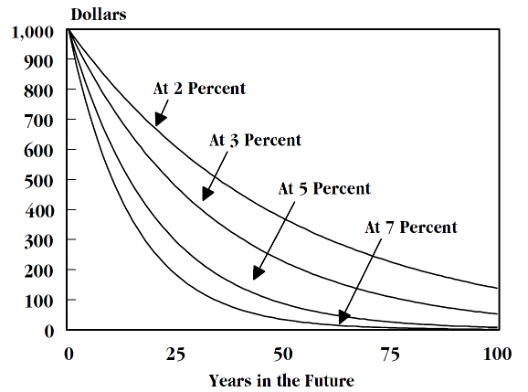
The present value of $1,000 received in the future, at four different discount rates. Small changes in the rate produce order-of-magnitude differences a century out. (CBO)
2. Geographic Scope: America First or Global Responsibility?
Carbon dioxide disperses globally, regardless of where it is emitted. Estimates suggest that American emissions cause 70% to 90% of their resulting damages outside U.S. borders: flooding in Bangladesh, crop failures in sub-Saharan Africa, intensified hurricanes in the Caribbean. This raises a fundamental question: should American regulators account for these foreign harms when calculating the social cost of carbon, or only count damages that occur within U.S. borders?
There are defensible arguments on both sides of this question, but it is ultimately a question about values and obligations, not a technical or scientific matter. Cost-benefit analysis is a tool for identifying policies that maximize social welfare, the overall well-being of a society. But it cannot tell us what the geographic boundaries of that “society” should be. Should we maximize welfare for Americans only, or for all people affected by American emissions? That is an ethical and political judgment, not an economic calculation.
Yet the SCC methodology treats this choice as if it were merely a technical parameter. The Obama administration included global damages in its calculations; the first Trump administration restricted consideration to domestic impactsonly, immediately reducing the calculated SCC by roughly 70% to 90%. This single choice, framed as a technical adjustment, encodes a fundamental judgment about American obligations to the rest of the world—a value choice hidden from public view and made to look like an objective and scientific decision.
3. Damage Estimation: Quantifying the Unquantifiable
Converting global average temperature increases into localized dollar-denominated harms requires modeling impacts across countless domains. The computer models used have been characterized by leading scholars as “extraordinarily crude.” While some harms admit rough quantification (e.g., agricultural yield changes), others resist meaningful monetization and are routinely omitted from SCC calculations entirely. These include:
- Loss of endangered species and habitats
- Ocean acidification
- The economic and political consequences of climate-induced migration
- Increased wildfire risk and ecosystem collapse
- The spread of insect pests and diseases
- Increased political conflict

Bleached staghorn and brain corals at Sombrero Reef, Florida Keys, during the 2023 marine heatwave. Reef collapse is one of the harms routinely omitted from social-cost-of-carbon calculations. (NOAA)
These impacts are not estimated poorly; they are excluded entirely, treated as though they will cause zero damage. The resulting SCC figures thus represent not the total harm from carbon emissions but only the fraction that existing models can quantify.
4. Extreme Outcomes: How Do We Price Catastrophe?
Conventional cost-benefit analysis relies on expected-value calculations. In plain terms, this means taking the average: multiply the severity of each possible outcome by how likely it is, then add the results together. This approach works well when outcomes cluster around an average and probability distributions are well-characterized. But climate change satisfies neither condition. Climate systems exhibit feedback mechanisms capable of amplifying initial warming in self-reinforcing cycles. For example:
- When Arctic permafrost thaws, it releases methane (a potent greenhouse gas), which causes further warming that thaws more permafrost.
- As forests die from heat stress, they release their stored carbon, accelerating the warming that killed them.
- As polar ice melts, it exposes dark ocean water that absorbs more solar energy than the reflective ice did, driving additional warming.

Methane bubbles trapped in an Alaskan thermokarst lake. As Arctic permafrost thaws it releases methane, a self-reinforcing loop whose tail risk sits outside standard cost-benefit models. (USGS)
In each case, the warming that begins the cycle accelerates the very process that produces more warming, making the endpoint genuinely hard to predict and extreme outcomes more likely than a simple average would suggest. When such feedbacks are potentially large but imprecisely quantified, probability distributions develop “fat tails,” meaning the chance of extreme catastrophic outcomes is far greater than standard probability distributions for most natural phenomena would suggest. Under certain plausible assumptions about climate uncertainty, the mathematical averaging process may break down entirely, producing infinite or meaningless results. In other cases, the analysis may be dominated by catastrophic scenarios that conventional cost-benefit analysis effectively ignores. How much weight policymakers should assign to these low-probability catastrophic outcomes is a question of risk tolerance, not empirical measurement. Cost-benefit analysis forces this judgment into technical parameters rather than exposing it for democratic deliberation.
Beyond the Numbers
The four sources of instability—the discount rate, the geographic scope, the damage estimation models, and the treatment of catastrophic risk—do not operate in isolation. They compound. A high discount rate shrinks future damage; restricting geographic scope to domestic impacts then eliminates most of what remains; conservative damage functions further reduce the surviving figure; and minimal catastrophe weighting discards the tail risks that might otherwise counterbalance these choices. Each assumption amplifies the others, producing not four separate modest distortions but a cascading effect. This is why the range is not $30 to $60 but $1 to $190 and beyond, and why credentialed economists working in good faith have produced estimates spanning from less than $0 to over $2,000 per ton—not because some are careless, but because two researchers making opposite but defensible choices at each parameter will produce wildly different numbers. The framework’s flexibility is not additive; it is multiplicative.
The compounding itself is telling. CBA is designed to identify efficient outcomes when underlying values are broadly shared and the key questions are empirical: How much will compliance cost? How many lives will be saved? Climate policy inverts these conditions. The empirical uncertainties are enormous, and the underlying questions—how much should present generations sacrifice for future ones, whether American regulators owe obligations to people beyond U.S. borders, how to weigh catastrophic but uncertain risks—are precisely the things people disagree about. Even CBA proponents Jonathan Masur and Eric Posner have acknowledged that these are “political and moral” judgments “for which cost-benefit analysis is not suited,” comparable in kind to applying CBA to abortion or Establishment Clause questions. The methodology cannot resolve such disagreements. It can only absorb them into its parameters and present the resulting number as though it were a finding rather than a choice.
The most serious objection comes from CBA’s defenders on the left. Richard Revesz and Michael Livermore have argued that a properly calibrated SCC would constrain discretion rather than disguise it. But their proposal does not solve the indeterminacy problem; it resolves the contested value questions in one direction and presents that resolution as a technical output. The methodology still provides no principled criterion for choosing between parameters. An ethical argument must do that work, and no formula can substitute for it. A further objection, that the SCC at least compels agencies to quantify climate harm, runs into the same difficulty: the second Trump administration simply eliminated the metric outright, demonstrating that even this constraint does not survive a president willing to reject the underlying science.
That translation carries a democratic cost. When value judgments enter the framework as discount rates and geographic scope selections, they become legible only to specialists. The public never debates whether a 3% or 7% discount rate better reflects our obligations to future generations—it debates whether the SCC should be $190 or $7, as though those numbers emerged from scientific measurement rather than from ethical premises baked into a formula. The Interagency Working Group that produced the Obama-era SCC operated without the formal notice-and-comment process(the public comment procedure that typically lets citizens weigh in before major regulatory decisions are finalized)—a process suited to resolving technical questions, not moral ones. The SCC framework thus does not merely fail to resolve normative disagreements; it forecloses democratic deliberation on them by disguising contested value choices as technical inputs that only economists can evaluate. The result is a tool that appears to constrain political discretion but in practice only conceals it.
Rather than seeking to optimize climate outcomes through damage monetization, policymakers could establish science-based constraints on acceptable atmospheric concentrations and then identify efficient pathways to compliance. The Intergovernmental Panel on Climate Change (IPCC) has concluded that global emissions must reach net zero around 2050 to limit warming to 1.5°C, a target also embedded in the Paris Agreement, reflecting not just a scientific consensus but a global political one. Treating such thresholds as constraints rather than variables to optimize would ground policy in physical science rather than contested economic speculation. Economics would then serve to identify least-cost compliance strategies rather than to determine whether compliance is worthwhile. This approach, known as the Marginal Abatement Cost (MAC) or “target-consistent” approach—as advocated by scholars like Noah Kaufman and Amy Sinden—sets an emissions ceiling derived from atmospheric science and then ranks available reduction measures from cheapest to most expensive until the target is met. The MAC approach does not eliminate normative discretion; it relocates it to the target-setting stage. But scientific estimates of dangerous concentration thresholds, while uncertain, do not exhibit the variability that characterizes the social cost of carbon. A safety standard grounded in atmospheric physics cannot be reduced by 98 percent through parameter selection alone.
Alternatively, many environmental statutes direct agencies to regulate to the limits of technological and economic feasibility rather than to some theoretically optimal point. Feasibility analysis does not require monetizing ecosystem collapse or discounting future generations’ welfare. It requires assessing what emission reductions current and emerging technologies can deliver at bearable cost. It does, however, embed its own contested judgments: what counts as “bearable cost” partly reflects what industry has chosen to develop. Neither alternative eliminates normative judgment. What they share is a structure that makes those judgments visible and contestable rather than embedding them in technical parameters.
The Bottom Line
The social cost of carbon has fluctuated from $42 to a few dollars to $190 within a single decade—each number not a refinement of the last but a wholesale replacement driven by political transition. Courts, investors, and policymakers who look to the SCC for guidance find no continuity across administrations and no basis for long-term planning.
Climate change presents real risks requiring substantive responses. Constructing those responses demands analytical frameworks that acknowledge what remains unknown, expose contested values, and provide guidance robust enough to survive political transitions. Cost-benefit analysis satisfies none of these criteria. Its continued dominance reflects political convenience rather than effectiveness. The specific alternative matters less than recognizing that an alternative is needed. A framework that can justify vastly different outcomes with equal methodological validity justifies none of them. The same ton of carbon dioxide cannot simultaneously cost $1 and $190, but the tool we use to price it says it can, and yet we keep using that tool.
