
China burns more coal than the rest of the world combined. It also manufactures more than 80% of the world’s solar panels and may have already peaked its emissions years ahead of schedule. It accounts for roughly a third of global CO₂ emissions—more than the United States, the European Union, and Japan combined. Yet under the United Nations Framework Convention on Climate Change (UNFCCC), the treaty that has governed international climate negotiations since 1992, it sits in the same legal category as Burundi, Somalia, and the Central African Republic: “developing.”
That classification is not simply wrong. China’s per capita emissions remain well below those of the United States, and roughly a quarter of its population (some 350 million people) still lives in poverty by the World Bank’s measure. But the label is not adequate either. The UNFCCC’s binary framework (developed countries in one column, developing in the other) was never built to accommodate a country that belongs, however imperfectly, in both—and its governing principle, common but differentiated responsibilities (CBDR), offers no middle ground.
Cass Sunstein’s recent book, Climate Justice, offers a better lens. Rather than sorting countries into two bins, Sunstein places climate obligations on a continuum: the more a country has contributed to the problem and the more it can afford to fix it, the more it owes. That means China owes more than the world’s poorest nations, even if its per capita emissions and development history give it legitimate claims that the United States and Europe cannot make. But what justice requires and what politics produces are different things. China’s climate actions are driven not by moral obligation but by domestic imperatives—energy security, economic competitiveness, regime stability. As Alex Wang’s research into China’s cadre evaluation system reveals, those imperatives are structural, not incidental. Deteriorating U.S.–China relations compound the problem, pulling apart the international cooperation that any effective climate regime needs to function.
The Dual Identity in Context
China’s emissions and its clean energy investments are each routinely cited in isolation, and the result is two distorted half-pictures. China’s annual CO₂ output exceeds that of the next three largest emitters combined. The China Knowledge Network (CKN) Clingendael report notes that China accounts for 58% of global coal consumption. The expansion is not slowing. In 2024 alone, China broke ground on 94.5 GW of new coal plants, accounting for 93% of global coal construction starts that year. On annual emissions alone, the case for treating China as a major developed-world polluter appears straightforward.
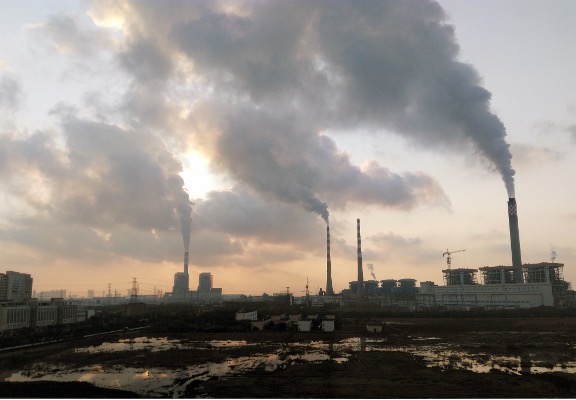
The Jiangsu Nantong coal-fired power station at dusk. Coal still supplies roughly 58 percent of China’s electricity.
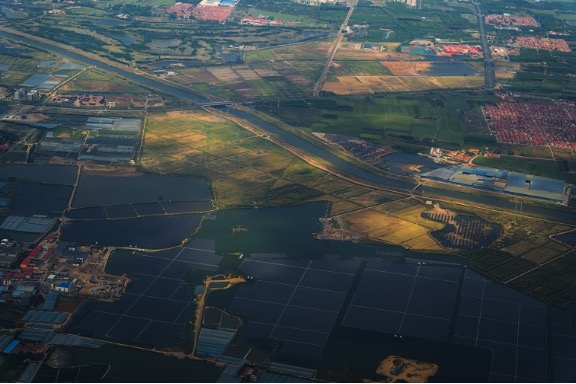
But the same CKN report documents that China’s combined solar and wind capacity now exceeds its coal capacity. In the first six months of 2024, China added enough clean energy to match what the United Kingdom’s entire electricity system produced in the same six months a year earlier. In 2024 as a whole, China added a record 373 GW of renewables. The puzzle is that both pictures are accurate.
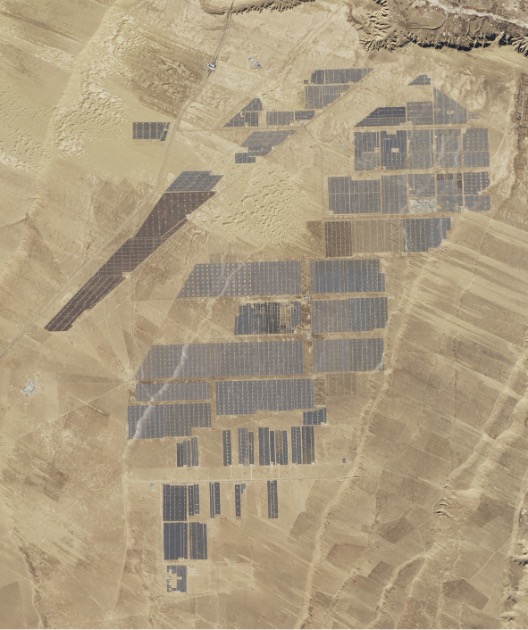
Satellite view of the Longyangxia Dam Solar Park in Qinghai. One of the world’s largest photovoltaic plants and an emblem of China’s clean-technology scale. (Planet Labs)
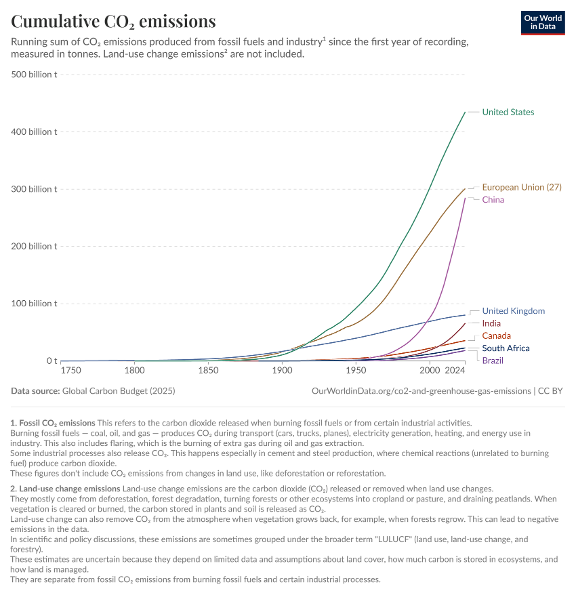
The question of which picture matters more for purposes of measuring responsibility is itself contested. As Robert Henson explains in The Thinking Person’s Guide to Climate Change, which metric applies—annual output, cumulative stock, or per capita figures—is a moral question, not a technical one: each embeds a different theory of who owes what to whom. On cumulative emissions, for instance, the United States has historically released 537 GtCO₂, roughly two-thirds more than China’s 312 GtCO₂. Additionally, Carbon Brief’s 2024 analysis shows that China’s per capita cumulative emissions (227 tCO₂) remain a small fraction of the U.S.’s (1,570 tCO₂). But some argue even those numbers overstate China’s moral debt, since a meaningful share of the carbon counted against China is emitted producing goods consumed abroad. These competing metrics reflect genuinely competing claims. The UNFCCC’s binary framework was not built to weigh them.
Sunstein’s Arguments for Wealthy-Nation Obligations
Corrective Justice: Who Caused the Harm?
Sunstein’s first argument looks backward. Corrective justice asks who caused the harm and demands compensation. As Posner and Sunstein explore, applying corrective justice to nations is complicated: today’s taxpayers, who didn’t cause the historical emissions that are driving current weather patterns, end up footing the bill for today’s flood victims. The loss-and-damage fund agreed to at COP27 represents the institutional expression of the corrective principle, but developing nations have called the roughly $800 million pledged so far grossly inadequate. A separate $300-billion-a-year climate finance target agreed at COP29 in 2024 has drawn similar criticism.
 And China, still classified as developing, bears no obligation to contribute at all. As Carmen Gonzalez argues in Migration as Reparation, high-emitting affluent states bear responsibility not only for emissions but for centuries of economic policies that deepened the Global South’s vulnerability. Gonzalez’s framing complicates China’s position further: a country that was itself subject to colonial extraction but now runs supply chains across the Global South does not fit neatly as either the harmed party or the one doing harm. A meaningful share of the emissions counted against it reflect demand from the very nations claiming corrective justice.
Distributive Justice: Who Can Bear the Cost?
Sunstein’s second argument looks forward. Distributive justice asks who is best positioned to solve the problem, regardless of who caused it. The logic is simple: a dollar matters less to those who have many. A 2023 UMass Amherst study found that the wealthiest 10% of American households generate 40% of U.S. greenhouse gas emissions, a reminder that climate inequality operates within nations, not just between them. Some go further: a dollar spent helping the worst-off counts for more, morally, than a dollar spent anywhere else.
China’s dual identity makes the distributive question especially hard. China’s $19.6 trillion GDP and its dominance in clean technology suggest enormous capacity to bear costs. But that aggregate coexists with 350 million people below the World Bank’s upper-middle-income line. The question is not whether China can contribute—it plainly can—but how to target its wealth without punishing its poor. The UNFCCC binary cannot pose this question at all; Sunstein’s continuum can at least try.
The Continuum Problem
Sunstein concludes that the case for wealthy-nation obligations survives imperfect application. Rough justice is still justice. But his most important observation for the China question is that obligations exist on a continuum. China, he writes, is not among the poorest nations, and to categorize it as poor is far too simple. As he puts it: “We are speaking of a continuum, not a dichotomy.”
This reframes the debate. Posner and Sunstein validate common but differentiated responsibilities (CBDR), the principle, first articulated in the UNFCCC, that wealthier, high-emitting nations bear greater duties, while noting that a simple allocation of financial responsibility proportional to per capita emissions would transfer hundreds of billions of dollars from the United States to China and India, and faces “decisive objections from the standpoint of feasibility.” Legal scholars disagree about whether CBDR should remain static or evolve dynamically as circumstances change. The International Court of Justice’s (ICJ’s) July 2025 advisory opinion on climate change reinforced this dynamic reading, holding that all states have obligations to prevent climate harm, with duties that scale alongside a nation’s emissions and capacity—the largest emitters bearing especially stringent duties of due diligence.
A fair objection is that developed nations could weaponize the continuum to shift burdens onto rising economies. Beijing has defended its developing-country status as a matter of principle, grounded in Global South solidarity. India, Brazil, and South Africa have backed this position, fearing it would erode their own differential treatment. The concern is legitimate. But the continuum calibrates CBDR rather than eliminating it. It simply insists that China’s burden differs in degree from that of Chad or Bangladesh, a claim difficult to contest on the merits.
What Actually Drives Chinese Climate Policy
Sunstein’s framework establishes what justice might require of China. Alex Wang’s research reveals what actually motivates Chinese environmental policy, and the disconnect is structural.
Wang documents a system driven by bureaucratic mandates rather than law or international obligation. The cadre evaluation system, through which Party officials are promoted or demoted based on measurable performance targets, is the central mechanism. Environmental targets entered the system only when pollution began threatening economic growth and social stability, most visibly after the 2013 air pollution crisis that blanketed major Chinese cities in hazardous smog and provoked a surge in public unrest severe enough that China’s own Ministry of Environmental Protection reported a 31% rise in environmental incidents (a category that includes protests alongside pollution accidents and industrial spills) that year, a statistic that reflected not just anger at pollution but a direct threat to the Party’s claim of legitimate governance. Once environmental targets entered that system, they carried real force: a local official who missed a pollution reduction target faced the same career consequences as one who missed an economic growth target. Demotion, reassignment, blocked promotion. The system that had long driven breakneck industrialization could now, with the same mechanical logic, drive cleanup. But it answers to the Party’s priorities, not to climate justice. Where Sunstein asks what a nation owes, Wang shows that China’s system asks only what serves the regime. The two questions occasionally produce the same policy but for entirely different reasons.
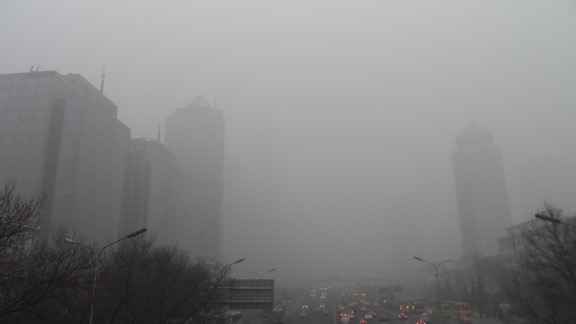
Beijing’s central business district shrouded in the 2013 airpocalypse. Public outrage that year pushed environmental targets into the Party’s cadre-evaluation system.
China’s climate motivations illustrate the point. Energy security is paramount. The 2021 energy crisis exposed dangerous fossil fuel dependence when power cuts shut down factories across provinces. Economic competitiveness follows; clean energy sectors now constitute roughly 11.4% of Chinese GDP. None of these drivers correspond to Sunstein’s obligations. China reduces emissions because doing so serves the Party’s imperatives.
The results are real, but the motivations matter for what comes next. The Climate Action Tracker’s November 2025 assessment projects that 2025 could mark the peak of China’s CO₂ emissions. Carbon Brief reported in February 2026, that emissions have been flat or falling for 21 months. Yet China’s September 2025 nationally determined contribution (NDC)—its first absolute reduction target, pledging a 7–10% cut from peak by 2035—was widely criticized as underwhelming, set below what current policies are already projected to deliver. Beijing framed the target as a floor, not a ceiling, pledging to “strive to do better”—but the confluence between stated ambition and existing trajectory raised questions about whether the target was designed to constrain or just to describe. If China has peaked years ahead of its “before 2030” target, the early achievement may paradoxically weaken the case for more ambitious pledges, since it allows Beijing to frame modest targets as already exceeded. That shifts its position on Sunstein’s continuum. But the shift reflects energy economics, not climate justice.
The Trade War and the Participation Problem
Even when domestic incentives push China toward decarbonization, geopolitics can push back. Deteriorating U.S.–China economic relations now pose a direct threat to global climate action.
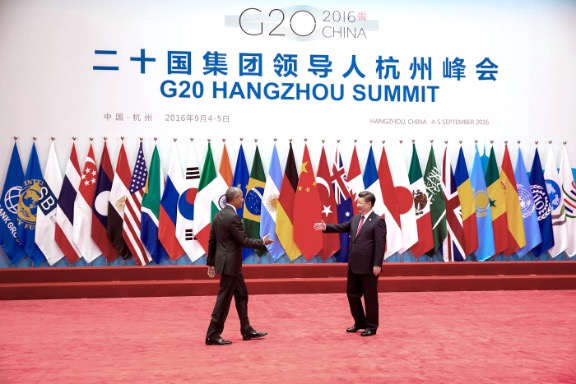
Xi Jinping greets Barack Obama at the 2016 G20 summit in Hangzhou. A decade later, U.S.–China climate cooperation has largely collapsed. (The White House)
Interdependence is concrete. China dominates global supply chains for lithium-ion batteries and rare earth minerals, the materials essential to wind turbines, EV batteries, and clean energy infrastructure. Disruptions between the two largest emitters reverberate across every supply chain decarbonization depends on.
That dependence is precisely what motivates the U.S. response. Bloomberg reported that tariffs on Chinese clean technology raise decarbonization costs globally. But Washington’s concerns extend beyond climate, including overcapacity dumping that undercuts domestic manufacturers, intellectual property theft, forced technology transfers, and the national security risk of depending on a strategic competitor for critical energy inputs. These are not trivial objections. Meanwhile, the domestic rollback of U.S. clean energy policy compounds the climate problem. E2’s Clean Economy Tracker found that over $22 billion in U.S. green energy projects were cancelled or scaled back in the first half of 2025 alone. The New York Times has documented the resulting bind: tariffs raise the price of the technology while the policy rollback kills the incentive to buy it. Whatever their merits on other grounds, the combined effect on decarbonization is severe.
Sunstein anticipated this. In his analysis of the Kyoto Protocol, he notes that full compliance by the participating industrialized nations alone would have reduced warming by only 0.03°C by 2100. Any approach to emissions reduction loses nearly all its point if only a few nations participate. This is the participation problem, and the trade war is making it worse. Sunstein’s continuum, which depends on calibrating obligations to capacity, cannot function when the two nations accounting for over 40% of global emissions are locked in an economic confrontation that makes cooperation toxic. Meanwhile, the consequences of climate change fall hardest on the nations least responsible. As Mohammed Hanif wrote of the 2022 Pakistan floods, the country needs “compensation for climate-related loss and damage,” not charity. The nations that contributed least to the crisis bear the greatest cost when the nations that contributed most refuse to cooperate.
The Path Forward
China’s position in international climate politics cannot be captured by the UNFCCC’s binary framework. Sunstein’s continuum does better; it acknowledges the moral weight of per capita emissions and CBDR while refusing to treat a $19.6 trillion economy as equivalent to the world’s poorest nations.
But Sunstein describes what justice requires, not what politics produces. Wang’s research shows that China’s climate investments are driven by concerns about energy security, economic strategy, and regime stability. That makes Chinese climate action durable when domestic incentives align with global goals and fragile when they do not. The trade war and the rollback of U.S. clean energy policy are pulling those incentives apart at precisely the moment when broad participation matters most.
If the continuum is the right moral framework, then the policy implication follows. The UNFCCC needs a logic that ties obligations to current capacity and emissions trajectory rather than to a 1992 snapshot. The Paris Agreement’s “ratchet mechanism,” which requires progressively more ambitious commitments every five years, offers a partial model. Currently, the ratchet applies only to emissions targets: each successive NDC must exceed the last. Extending that dynamic principle to differentiation itself, so that a nation’s category of financial obligation evolves alongside its economy and emissions profile, would let responsibilities escalate as capacity grows, without requiring the politically impossible step of formal reclassification. Rather than formal reclassification, which Beijing would reject and India and Brazil would resist, the trigger could be a graduated scale tied to objective indicators already tracked under the Paris Agreement: a country’s emissions trajectory and its GDP per capita. As Voigt and Ferreira have argued, the Paris Agreement already contemplates obligations that evolve with national circumstances; the next step is to apply that logic explicitly to financial contributions. China’s own September 2025 decision to voluntarily forgo “special and differential treatment” at the World Trade Organization (WTO) suggests that graduated adjustment, when framed as sovereign choice rather than external imposition, is not beyond reach.
The gap between what justice demands and what geopolitics delivers is the central tension of international climate policy. The moral case for cooperation is strong. The practical incentives for defection are stronger. And the atmospheric physics that will ultimately determine the outcome is indifferent to both.
