
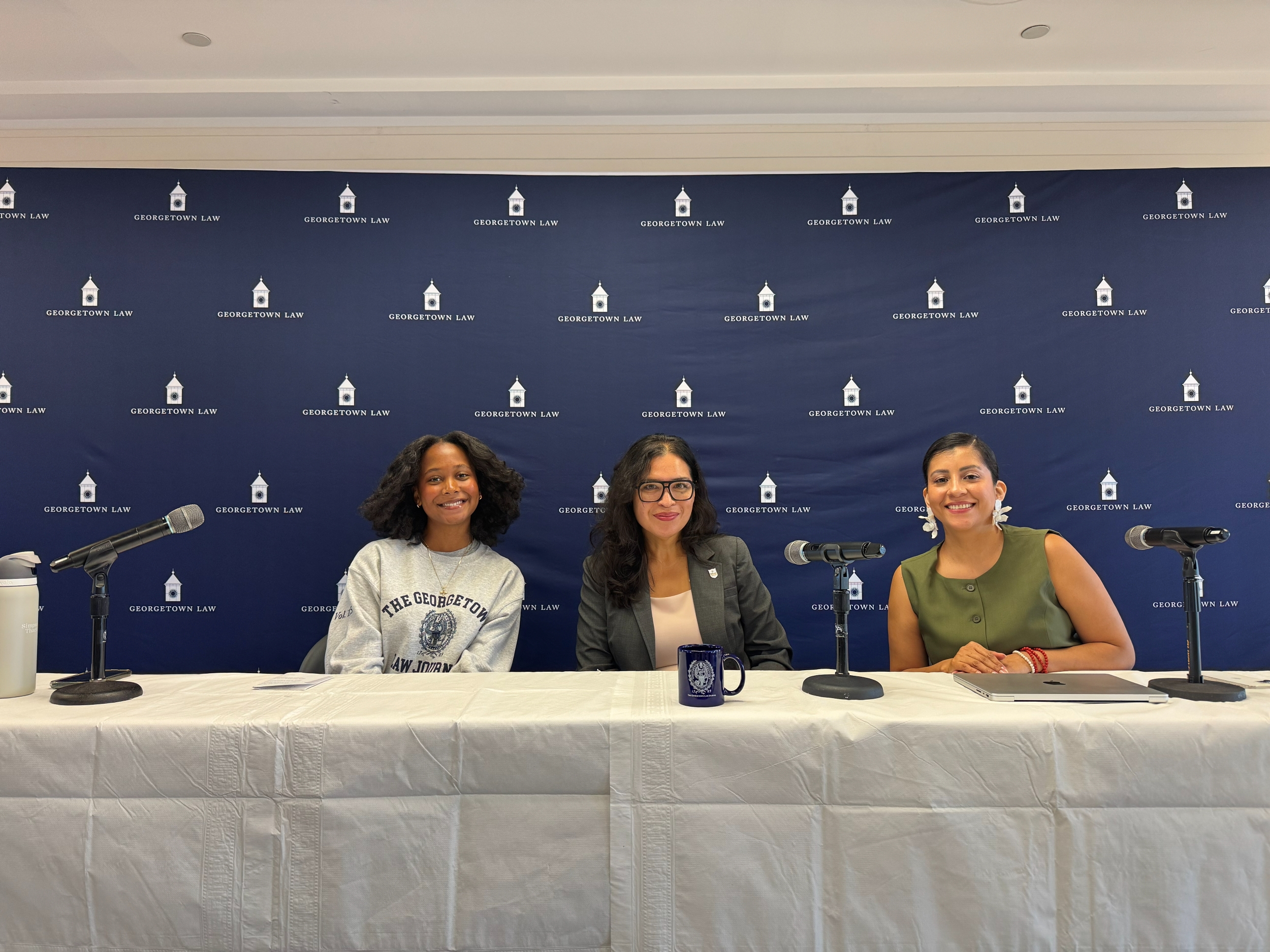
On August 21, The Georgetown Law Journal invited Professor Evelyn Rangel-Medina and me to speak with its incoming editorial staff about the process of developing legal scholarship. Our Article, Blood, Soil, and Race: The Perils of Shredding the Fourteenth Amendment, was  published in The Georgetown Law Journal Online only days after the panel. Following more than a year of researching, writing, and revising together, the conversation gave me a chance to reflect on how the Article had evolved—and on how my own approach to legal scholarship had changed with it.
Before law school, I earned a Ph.D. in anthropology at Temple, where my research focused on tourism, visual culture, and environmental change in the Marquesas Islands, French Polynesia. Anthropology trained me to pay attention to the categories institutions create, the assumptions behind them, and their consequences for the people subject to them. When I came to law school, I began encountering many of the same questions in a different register: through doctrine, legal institutions, and the categories law itself constructs.
 In Professor Rangel-Medina’s Latinxs and the Law seminar, those interests led me toward questions of citizenship. Who does the law recognize as a member of the political community? How have those boundaries been constructed historically? And what happens when categories of legal membership become intertwined with race, immigration status, and national identity? Those conversations ultimately helped lay the groundwork for our collaboration on birthright citizenship.
Our Article grew out of President Trump’s January 2025 executive order challenging the prevailing understanding of birthright citizenship and the litigation that followed. The Order reopened a constitutional question long treated as settled: whether the Fourteenth Amendment guarantees citizenship to children born in the United States to parents who are unlawfully or temporarily present. The Supreme Court ultimately agreed to take up that question. Our Article situates that challenge within a longer history of race, citizenship, and belonging in the United States.
As we worked through the doctrine and history, I kept returning to questions familiar from anthropology: What does it mean for the state to define who belongs? How do legal classifications shape understandings of membership beyond the rights formally attached to them? Citizenship has concrete legal consequences, but it also carries powerful ideas about identity, recognition, and membership in a political community. Working with Professor Rangel-Medina on an amicus brief in the litigation added another dimension to the project. Moving between scholarship and advocacy sharpened my attention to doctrinal argument and strengthened the legal analysis I brought back to the Article.
Professor Rangel-Medina’s scholarship on immigration, citizenship, and race gave us common ground from which to approach these questions. Our conversations moved among doctrine, history, and social theory, and the collaboration gave me room to bring the instincts I had developed as an anthropologist into sustained conversation with legal analysis. Over time, the project became an exercise in thinking across disciplines, with anthropology and legal analysis shaping the questions we asked and how we approached them.
The legal landscape, meanwhile, refused to stand still. In June, the Supreme Court decided Trump v. Barbara while our Article was still moving through the editorial process. Then, on August 6, the administration issued two additional executive orders, one responding to the Court’s decision and another addressing birth tourism. Each development required us to return to an argument already well underway and ask what, if anything, the changing landscape required us to reconsider. The editors at The Georgetown Law Journal were thoughtful partners in that process, helping us respond to developments that continued almost until publication.
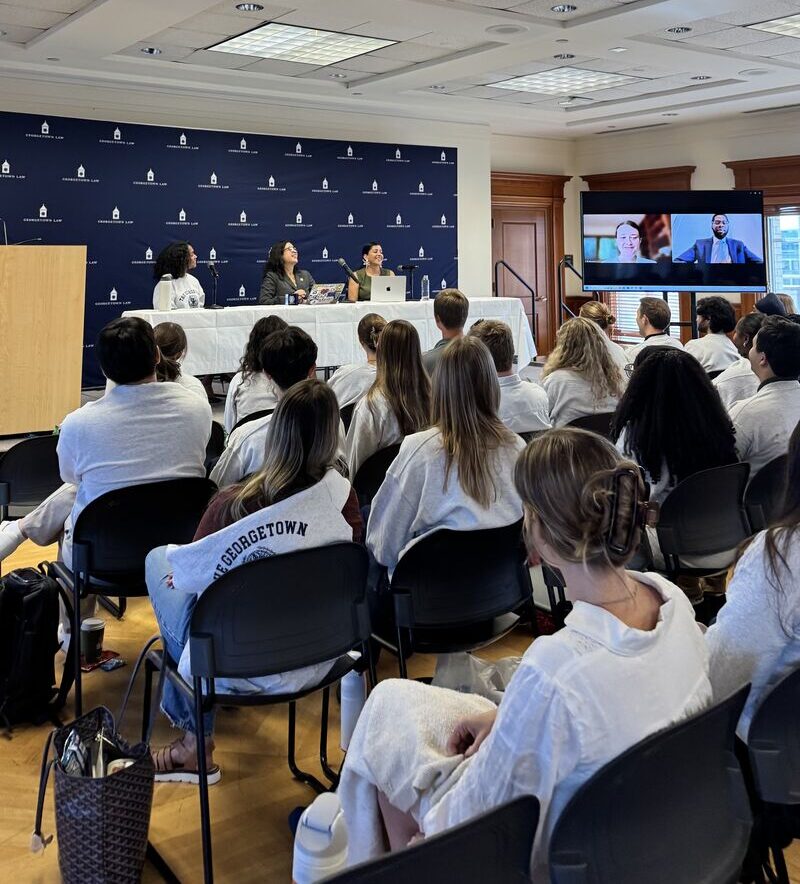 The Author Panel also gave me the chance to hear how other Volume 115 authors, Maybell Romero and Kenechukwu Okocha, approached their work. We discussed where our projects began, how they evolved, and our experiences working with the journal. Although the subjects and methods varied considerably, each piece had a history largely invisible on the finished page: abandoned ideas, unexpected turns in the research, and editorial questions that prompted another look. That conversation was a useful reminder of how much scholarly work consists of revision, reconsideration, and a willingness to follow the research somewhere unexpected.
My own path to the Article owes a great deal to the opportunities I have had at Temple Law. Faculty here have encouraged me to follow questions across disciplinary and doctrinal boundaries and to develop them through legal research. My collaboration with Professor Rangel-Medina has been an especially meaningful part of that experience, allowing me to work through these ideas alongside a scholar whose work I deeply respect. I am already carrying this socio-legal approach into other projects, this time in bankruptcy, where I am exploring questions about how law defines financial distress, structures access to debt relief, and draws the boundaries of bankruptcy itself.
I still think like an anthropologist, and I suspect I always will. Law has given me another way to think about institutions, power, and belonging, while anthropology continues to influence what I ask of law. Increasingly, I see my scholarship emerging from the conversation between the two. I am grateful to Temple Law for supporting the development of my approach to legal scholarship and to Professor Rangel-Medina for trusting me as a collaborator.
