Author: Craig Green

The Supreme Court of the United States

Garland deserves a fair hearing, Sen. Toomey

U.S. Sen. Pat Toomey recently wrote an op-ed to explain why he opposes Chief Judge Merrick Garland’s U.S. Supreme Court nomination. Any senator has the right to oppose judicial nominations, but it is flatly irresponsible for Toomey to deny Garland a hearing or vote until the next president takes office in January 2017, or later. Toomey supports this long wait for the political goal of maintaining a conservative majority on the court, and that is unprecedented. It is bad enough that an eight-justice court cannot resolve the country’s hardest legal problems for a year or longer. However, the long-term impact of Toomey’s position for future nominees could be much more destructive. No Supreme Court nominee in history has been rejected – much less denied a hearing – simply because a Senate majority used its muscle to demand nominees that fit its ideological preference. Toomey’s op-ed described Garland as “a pleasant man with impressive legal training and experience.” “President Obama could have chosen dozens of nominees who would be more politically liberal than Garland, but no …

AUDIO: The Supreme Court’s Loaded Gun

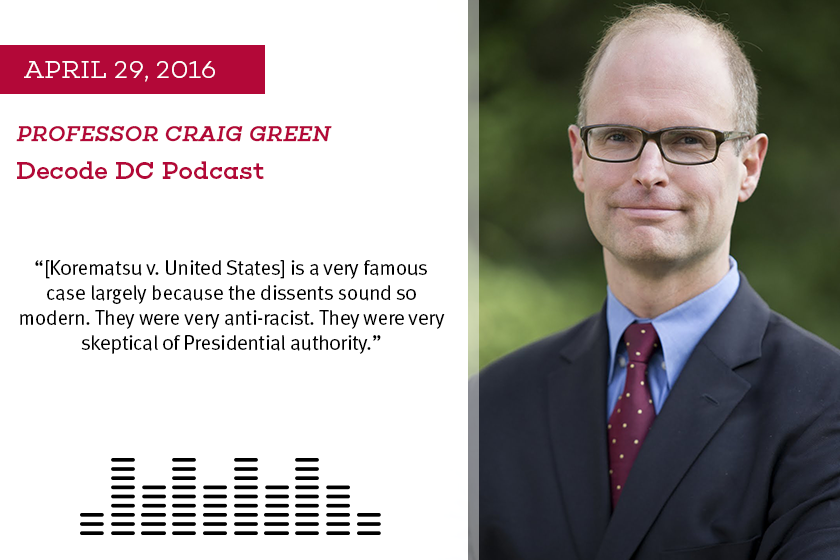
Professor Craig Green joins the Decode DC podcast to talk about the 1944 U.S. Supreme Court decision in Korematsu v. United States, which validated putting American citizens in internment camps during wartime, based on their race or ethnicity. The court has never overturned the Korematsu decision, and as the 2016 presidential election approaches, the debate over the case has new life. Listen to the Podcast

Kaleidoscope

Turning the Kaleidoscope: Toward a Theory of Interpreting Precedents

A full generation of legal scholarship has analyzed methods of interpreting statutory and constitutional provisions. Different works have emphasized text, original intent, original reception, and dynamic “living” meaning as academics have argued over which methodological systems describe current practice, and which systems are normatively best. Comparable methodological debates have not occurred with respect to judicial decisions. This Article examines precedents as a third category of legal authorities that — much like statutes and constitutions — sometimes present vague answers to important legal questions. This Article’s system of precedential interpretation will challenge unexamined intuitions about “reading cases,” with collateral implications for statutory and constitutional interpretation as well. I consider four categories of historical materials to generate different sorts of precedential meaning: (i) an opinion’s text, indicating a decision’s declared meaning; (ii) adjudicative context, reflecting a precedent’s implied meaning; (iii) reception by contemporary analysts, which depict understood meaning; and (iv) subsequent doctrinal applications, which identify developmental meaning. These categories offer analogies to forms of textualism, originalism, and dynamism that are well known in other legal contexts. Different …

Craig Green Radio Times Merrick Garland

LISTEN: President Obama’s Supreme Court Nomination: A Look at Merrick Garland and Reaction Across Capitol Hill

On March 16th, President Obama announced his nominee for the Supreme Court, Judge Merrick Garland. Senate Majority Leader Mitch McConnell has repeatedly said that the next president will decide the next supreme court justice. Professor Craig Green joined WHYY’s RadioTimes to discuss Obama’s selection, its implications, and any potential impact on the 2016 campaign. Listen to the Episode 

Turning the Kaleidoscope: Toward a Theory of Interpreting Precedents

A full generation of legal scholarship has analyzed methods of interpreting statutory and constitutional provisions. Different works have emphasized text, original intent, original reception, and dynamic “living” meaning as academics have argued over which methodological systems describe current practice, and which systems are normatively best. Comparable methodological debates have not occurred with respect to judicial decisions. This Article examines precedents as a third category of legal authorities that — much like statutes and constitutions — sometimes present vague answers to important legal questions. This Article’s system of precedential interpretation will challenge unexamined intuitions about “reading cases,” with collateral implications for statutory and constitutional interpretation as well. I consider four categories of historical materials to generate different sorts of precedential meaning: (i) an opinion’s text, indicating a decision’s declared meaning; (ii) adjudicative context, reflecting a precedent’s implied meaning; (iii) reception by contemporary analysts, which depict understood meaning; and (iv) subsequent doctrinal applications, which identify developmental meaning. These categories offer analogies to forms of textualism, originalism, and dynamism that are well known in other legal contexts. Different …