
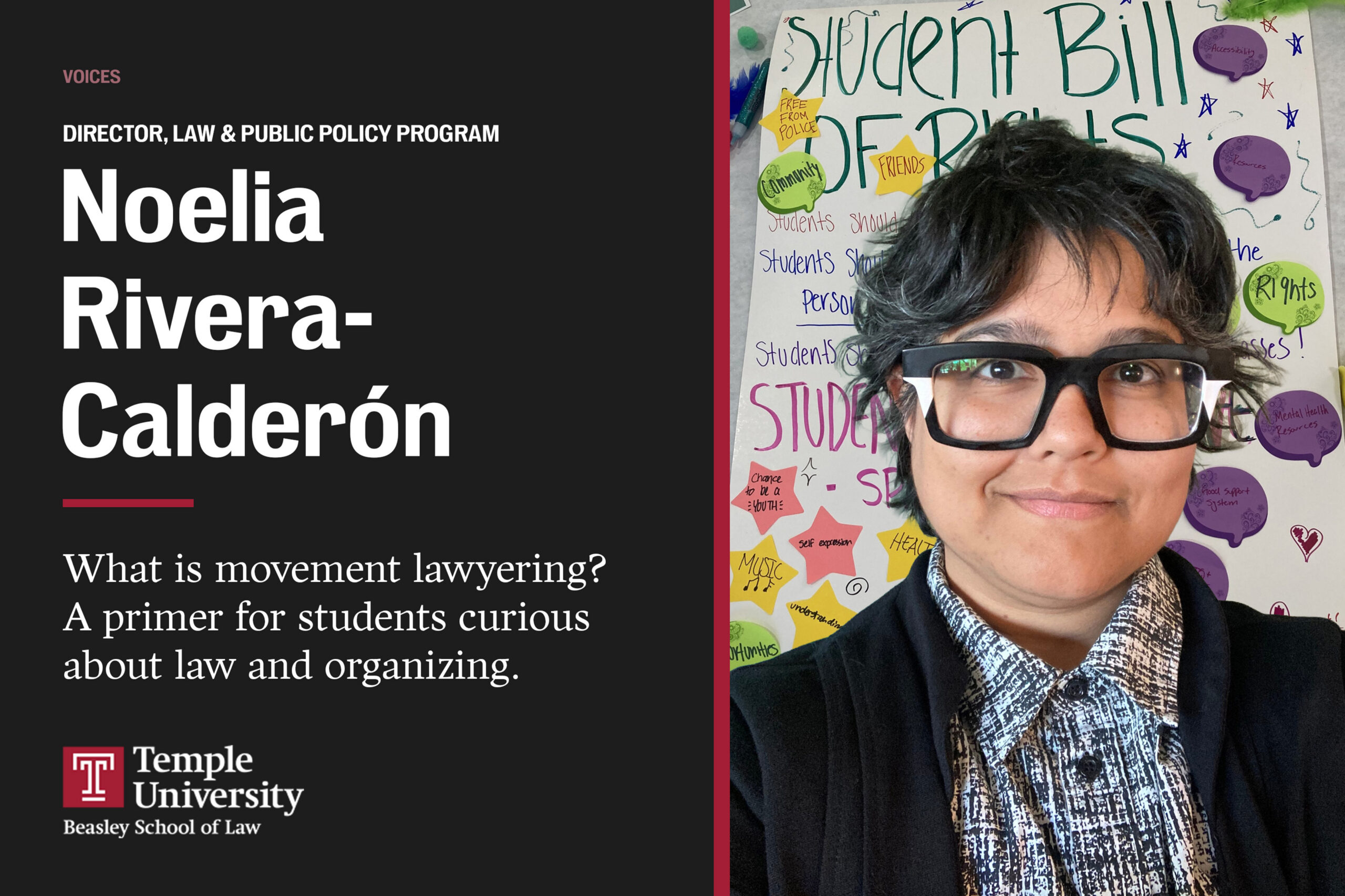
As a former middle school teacher, what brought me to Temple Law as a student was a not-fully-defined goal of partnering with youth to address education injustice through policy change. At the time I didn’t have the language of “movement lawyering” to describe my goal, but was fortunate to end up at the movement lawyering organization Advancement Project as an attorney on the education justice team. In this role I partnered with youth organizers across the country to provide legal and policy support for their education justice campaigns. We took on school policing, strengthened Sanctuary Schools policies, and built campaigns for school mental health from the ground up. I am honored to continue partnering on some of this work now.
Returning to Temple as faculty, I was excited to see so much interest in movement lawyering among the student body. I also often receive questions (and sometimes field misconceptions) about what exactly movement lawyering is, questions that inspired me to write this piece based on my experience.
To clear up a few things at the top: I wouldn’t say movement lawyering is about a particular subject matter or even a type of practice (litigation, transactional, legislative, etc.). It is not exactly synonymous with public interest lawyering, impact litigation, or even social justice lawyering. What makes movement lawyering distinct is its theory of change. A theory of change is essentially an understanding of how change happens that shapes your strategy for impacting it.
There are plenty of theories of change relevant to lawyers. They may involve heroic lawyers making the right arguments in court, providing adequate access to legal remedies, strengthening our institutions, or improving access to legal information. While all valuable, these theories all tend to center lawyers as the primary agents of change. In movement lawyers’ view, social change is driven primarily by social movements successfully building and exercising power. In addition to decentering lawyers, this lens also creates distance from the premise that our legal institutions would be fundamentally just if only they worked “correctly.”
I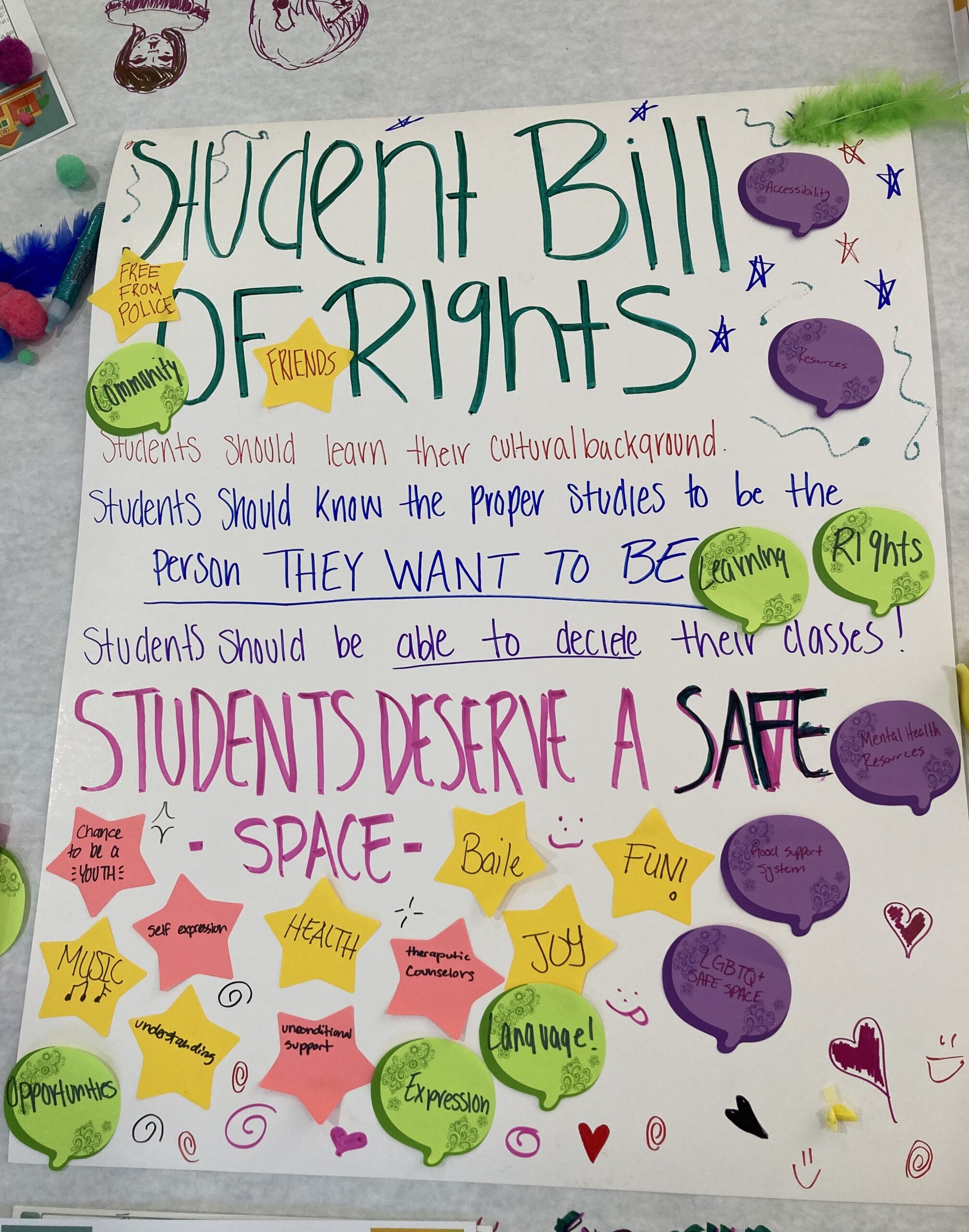 f we recognize change as not primarily driven by lawyers, then what is the movement lawyer’s role? My experience has shown me the value of lawyers showing up in collaborative partnership with organizers within movements for social change.
In law, we center the attorney/client relationship as the way that lawyers relate to everyone else. But when I collaborate with organizers, we are partners in the context of the broader movement, all of us working toward movement goals. It is a relationship of equals with shared goals, each bringing strengths, valuable perspectives, and skills. It may or may not fit the traditional attorney/client model, depending on the strategy we pursue. As a lawyer, I can be a thoughtful strategic partner by using my legal knowledge and skills to identify when partners are incorrectly told by decisionmakers that policy change is not possible, to open possibilities by suggesting legal paths forward, and to advance our movement goals through any tactics required.
This partnership requires humility on the lawyer’s part. I’ve lost track of how many times I’ve heard from organizers and community members some variation of: The lawyers come and all they do is tell us no, we don’t have a case, or we don’t understand how the law works. Instead, we can begin our work from the understanding that people with lived experience of injustice know very well how the law works (they have been on the receiving end of its harms), and that organizers know—in ways lawyers often don’t—how to build power and exercise it to impact change. When I began in this work, it was like a missing piece of the puzzle clicking into place: the strategic frameworks for impacting policy change that I had never learned in law school and that our organizing partners had in abundance. Law and organizing can make for an incredibly strong and meaningful partnership.
Because a “win” is defined based on whether movement goals are advanced (beyond “did we bring a case and did our arguments win”), this work can require a high degree of versatility. My day-to-day practice has included everything from researching existing policy and filing open records requests to inform campaign strategy; meeting regularly with organizing partners; facilitating educational and/or policy development workshops with youth; collaboratively turning youth demands into policy language; co-writing reports, toolkits, and accessible explainers; joining organizing partners in decisionmaker meetings; litigating to advance movement goals; and on and on. There is no one thing I’d do every day. Working in partnership with social movements requires many tools and tactics.
While we often work in challenging landscapes, the creativity and versatility this work requires can also be invigorating. Though the stakes can be high and the work is often hard, the solidarity we practice strengthens us all. In a profession that can be oriented toward the achievements and expertise of individuals, shifting from “I” to “we” in our lawyering—from (savior) attorney and (saved) client to partners in the movement—becomes radically impactful.
To students interested in movement lawyering: if you aren’t already, become involved in movements for change. Show up, take part, and learn. At Temple Law, consider the Law & Public Policy Program I direct, which has this approach to lawyering as a throughline throughout its coursework. Several other Temple Law faculty have movement lawyering experience and connections that inform their courses and clinics. Feel free to reach out to me any time to chat more and make these connections.
Noelia Rivera-Calderón, LAW ’19, is a practice professor of law and director of the Law & Public Policy Program.
