Archives

How the Tech Justice Clinic Opened Doors I Had Previously Closed

Long before law school, I had aspirations of pursuing a PhD in Media Studies. After writing a Bachelor’s thesis on diva worship among gay men on Twitter (yes––it was Twitter when I wrote it!), I moved to Amsterdam where I wrote a Master’s thesis on Chechen police violence enacted against gay men via Grindr (a gay dating app). I had, and still have, big questions surrounding privatized media environments, freedom of expression, internet sovereignty, surveillance and control, and the interplay between physical bodies and their digital counterparts. I was heading down the academic pathway when Covid hit and changed the trajectory of my career.   Years later, I found myself in law school. I entered law school extremely skeptical of the field––a field that has a reputation for being rigid, limiting, and unyielding. I was convinced that this critical media training I went through would necessarily be cast aside in pursuit of more “concrete,” legal analysis. To be sure, my background in critical media studies did not come up much during my 1L year. But in …


Why You Should Be Learning More About Compliance & Ethics Right Now

What is compliance & ethics? As a law student, it is impossible to know every legal career path, and compliance and ethics is one path that may seem particularly abstract. As one NYU law professor explains, “The compliance function consists of efforts organizations undertake to ensure that employees and others associated with the firm do not violate applicable rules, regulations or norms. It is a form of internalized law enforcement which, if it functions effectively, can substitute for much (although not all) of the enforcement activities provided by the state.” [1] Put simply, employees in a compliance and ethics role at different organizations work to ensure that their organization and its constituents comply with the applicable laws and regulations. This may entail establishing and enforcing corporate policies to address federal and state laws, holding compliance training sessions for employees at all levels within the organization, and creating an infrastructure for anonymous reporting of violations. Although such a process may resemble what in-house attorneys do, companies are increasingly compartmentalizing the compliance and ethics function into its …

How Earning an LL.M. Can Help Internationally Trained Lawyers Gain Practical, Legal Work Experience in the U.S.

Ally Lamson, Esq. is Temple Law’s Assistant Director for Global Legal Studies. She supports international LL.M. students by providing career advice for both domestic and international opportunities, such as reviewing resumes and cover letters, searching for jobs and internships, and conducting mock interviews. Prior to this role, Ally worked as a family lawyer and assisted her firms in hiring legal talent. If you have any questions or would like to connect with Ally, you can email her here. Q: How can earning an LL.M. help internationally trained lawyers gain practical, legal work experience in the U.S.? A: It’s common for students to look for legal work experience in the United States while they are in law school or immediately following their LL.M. degree, even if they intend to return to their home countries to practice law. Here are five ways in which foreign-trained lawyers can best position themselves to acquire meaningful exposure to the U.S. legal profession. Select an LL.M. program with options: Many LL.M. programs develop practicums specifically for their LL.M. students, which involve …

Human Rights Protections Through International Criminal Law

One of the tools in the toolkit of human rights protection is international criminal law. However, application of this body of law is generally limited to the most serious human rights violations: atrocity crimes. In her recent book, Shocking the Conscience of Humanity: Gravity and the Legitimacy of International Criminal Law, Professor deGuzman examines what it means for crimes to be so grave that they concern all of humanity. She shows that the concept of gravity remains highly undertheorized, and uncovers the consequences for the regime’s legitimacy of its heavy reliance on this poorly understood idea. She argues that gravity’s ambiguity may at times enable a thin consensus to emerge around decisions, such as the creation of an institution or the definition of a crime, but that, increasingly, it undermines efforts to build a strong and resilient global justice community. Having elucidated the consequences of the regime’s reliance on the ambiguous idea of gravity, Professor deGuzman suggests how gravity could be reconceptualized to take account of global values and goals in the various decision-making contexts …

Reflections on AIDS Awareness Month and the Case for Public Health Law Research

As we observe AIDS Awareness month this December, we find ourselves looking back on the most challenging year from a public health perspective in at least a century. The current pandemic places all of us at the direct crossroads of public policy and public health in a daily reality unrivaled in most of our previous experience. Thinking about the impact of school and business closures, restrictions on gatherings and travel, mask mandates, and how to distribute vaccines highlight just a few of the law and policy responses we now interact with to keep ourselves and each other safe. As we pause each year to recognize those living with HIV, and remember those lost to AIDS, the condition caused by the virus, we must also remember that we suffer many of those losses, especially the early ones, because of the original failures of the public health response to the HIV epidemic. These failures included but are not limited to a minimization of the government’s role in public health response and related delays to address the spread …

An Unofficial Overview of Temple Law’s Competitive Offerings

Introduction Being on a law review, moot court, or trial team gives students valuable advocacy practice and looks great on a resume, however competition can be fierce. Thankfully, Temple has numerous opportunities to participate in these prestigious offerings. With five moot court teams, two law reviews, a trial team, and a patent drafting competition, there are many options for students to choose from. Academic credit is provided for participation. Note that all of these are subject to change, and Temple may not participate in all competitions every year. Where to begin? Read all about them below! Law Reviews Temple has two law reviews: The Temple Law Review and Temple’s International and Comparative Law Journal. The Temple Law Review was founded in 1927. It is a student-edited, quarterly journal dedicated to providing a forum for the expression of new legal thought and scholarly commentary on important developments, trends, and issues in the law. Students must compete in the write-on competition to be considered for membership. This competition usually takes place about a week after spring finals. …

My Spring Semester at Temple Law’s Japan Campus

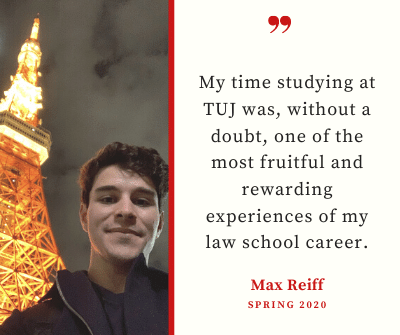
My time studying at Temple University Japan campus (TUJ) was, without a doubt, one of the most fruitful and rewarding experiences of my law school career. As a Program, TUJ is incredibly well integrated as an American university in a sprawling foreign metropolis. As a country, Japan is amazingly sophisticated and well worth understanding for those curious to understand the future. If you are someone who enjoys adventure, has international aspirations, or is innately curious, I cannot recommend this program enough. Educationally, classes are well-integrated for those considering careers in international law or seeking an added dimension to their personal brand. The added benefit of small classes allowed me to personally connect with professors on an intimate level not possible elsewhere and obtain quality mentorship from international field leaders. Professionally, TUJ helped arrange fantastic internship opportunities at top-notch organizations, assisting students to gain valuable experience and build upon their CV’s. With opportunities at global firms like Morgan Lewis and BMW, students have the chance to network, experience life as an international practitioner, and strengthen their …

Sheller Center Students File Tort Claims for Families Separated at the Border

The Trump administration has engaged in a policy of family separation, which it ramped up in 2018. Under that policy, families apprehended for crossing the border outside of a port of entry were forcibly separated. Parents were placed in adult detention while their children were sent to shelters for unaccompanied minors. They were frequently subjected to cruel conditions of confinement, including overcrowding and the inability to obtain adequate nutrition, hygiene, medical care or mental health services. Notably, the administration expressly announced its family separation policy as a tactic to deter Central American migrants from seeking safety in the United States. In these facilities, parents and children endured weeks or even months without contact with one another. Parents and their children did not know when or if they would be reunited because immigration officials would not provide any information. The separation of parents from their children has predictably caused significant and long-lasting trauma to these families who had sought refuge in the United States. Through the Sheller Center for Social Justice, we represented eight families in …

Temple Law Faculty React to the Bostock v. Clayton County, Georgia SCOTUS Decision

On June 15, 2020, Supreme Court Justice Neil Gorsuch delivered the 6-3 opinion in Bostock v. Clayton County, Georgia, holding that employment discrimination on the basis of sexual orientation or gender identity is prohibited under Title VII. The landmark decision is widely viewed as an historic moment in the movement for LGBTQ equality. Leonore F. Carpenter Associate Professor of Law Don’t underestimate the enormous power of this decision. Everyone loved the marriage decisions because everyone loves love. But frankly, not everyone has any desire to get married. However, in a nation with a fraying social safety net, job security is absolutely critical to all of us, particularly those on the economic margins. In my mind, this decision is at least as important as Windsor or Obergefell.   Ellie Margolis Professor of Law The Bostock decision is a huge victory for legal equality in this country. It will provide a measure of security to countless LGBTQIA workers who no longer have to fear losing their jobs because of who they are or who they love. The …

Intellectual Property Law Society | Student Organization Voices Series

Your Name: Catherine Cuff Graduation Year: May 2020 Name of Organization: Intellectual Property Law Society (IPLS) Position in Organization: President Temple Law School: When did you join this organization? Catherine Cuff: I joined IPLS as a 1L my first year at Temple. I worked in IT prior to law school and knew I was interested in the subject. I made sure to sign up at the student activities fair. TLS: Why did you decide to join this group? CC: With our society relying more and more on technology I wanted to better understand how law and science interact. I also wanted to demonstrate to employers that this was an area of interest for me. Embarrassingly, I’ve always had a bunch of crazy ideas for inventions. I wanted to learn how to make them reality! TLS: What is your organization’s mission? CC: The purpose of IPLS is to promote the discussion of legal challenge presented by technological advances through speakers and events. We want to connect students with this wonderful field of law! TLS: Can you …