
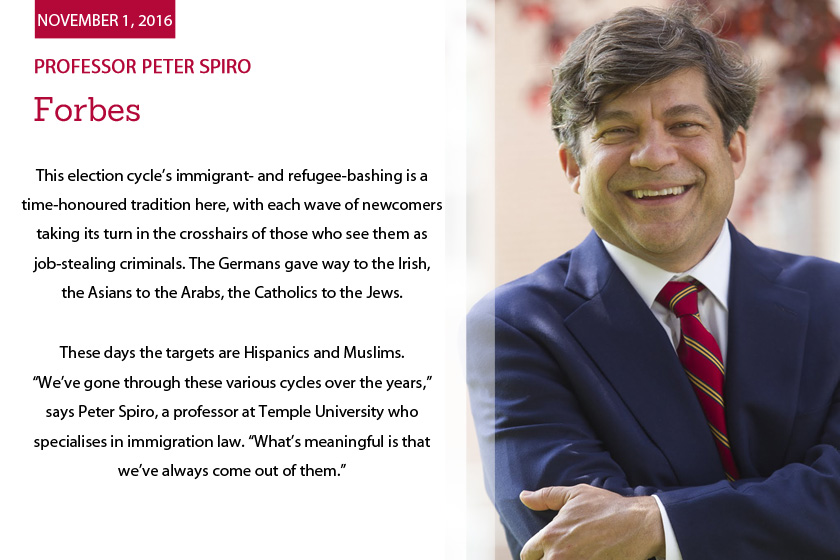
The American Dream is Alive and Well…
Professor Peter Spiro is quoted in this article from Forbes India. Read the Full Article
Professor Peter Spiro is quoted in this article from Forbes India. Read the Full Article

The unexpected result in the British referendum is hitting the news today like a thunderclap. As the financial markets tumble, few will escape Brexit’s consequences. But none will feel Brexit more than those whose employment and residential security have been contingent on the UK’s continued EU membership. An estimated 3 million citizens of other EU member states live in the UK. Meanwhile, 1.3 million Brits live in other EU member states. For this population, Brexit spells uncertainty, at least. No more will moving across the Channel for work, study, and other purposes be almost as easy as moving across the Hudson River from New York to New Jersey. Getting another nationality will in many cases be the answer. Think citizenship insurance. Free movement rights formerly guaranteed under the EU treaty regime will be up for grabs. Those who are allowed to stay will face visa applications, registration regimes, and other bureaucratic hassles. Others may face expulsion. As EU citizens – a status that comes with citizenship in an EU member state — these individuals have …

As it is wont to every few years, dual citizenship has become a contentious issue in contemporary politics. In the wake of the November 2015 attacks in Paris, French President François Hollande is pressing for a constitutional amendment that would allow convicted terrorists with dual nationality to be stripped of their French citizenship. Political elites on the French left have attacked the proposal as violating principles of equality, as it does not apply to citizens of only France; the move, they argue, would signify that dual nationals are somehow less French and that their French identity is more expendable than those who don’t have another citizenship. In December the U.S. Congress barred dual nationals of Iran, Syria, Iraq and Sudan from visa exemptions that they would otherwise enjoy as citizens of European Union nations and certain other countries. The measure — which a group of senators is now proposing to alter — also restricts the visa-free movement of individuals who have recently traveled to these countries, on the theory that it would prevent potential jihadists from re-entering the …
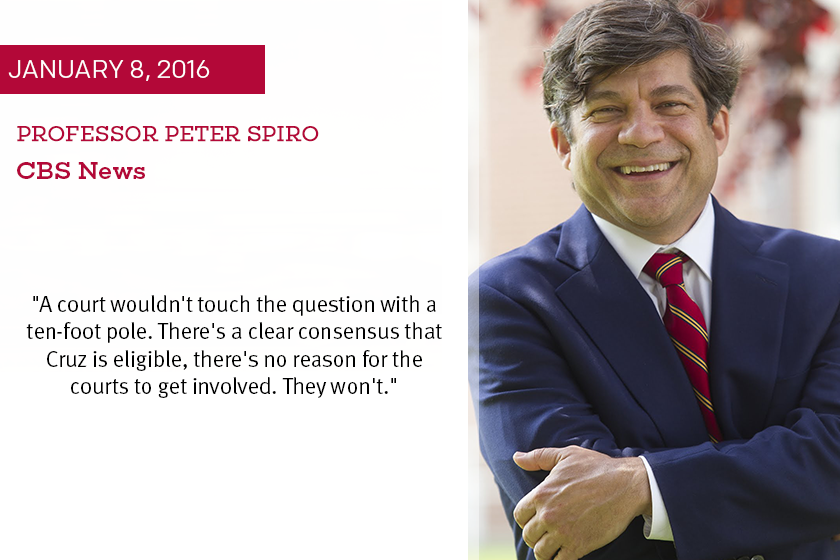
Professor Peter Spiro is quoted in this article by CBS News regarding the “free legal advice” Donald Trump has offered Senator Ted Cruz regarding his citizenship. Is Cruz able to get a declaratory judgment to settle his eligibility? Professor Peter Spiro says it’s not that simple. Read the Full Story
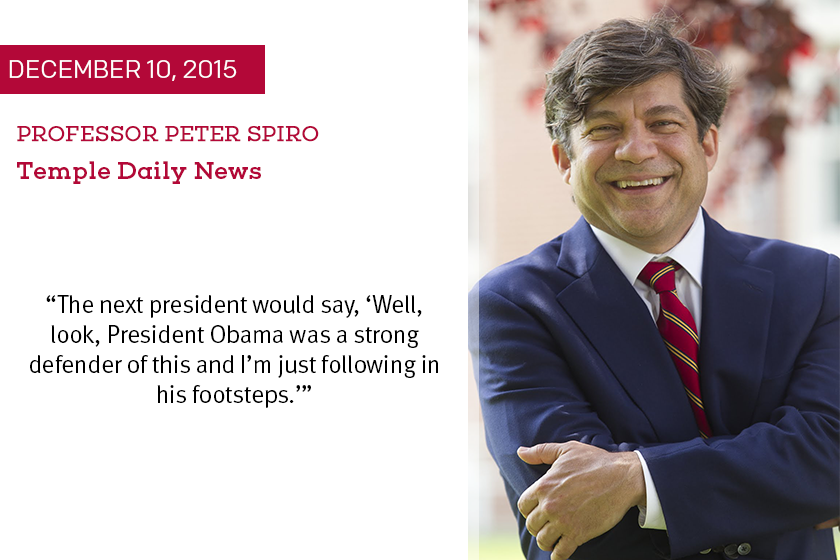
Professor Peter Spiro is quoted in this article by the Temple Daily News on why executive actions by President Obama could give future presidents political cover, particularly in the area of immigration. Read the Full Article.

Donald J. Trump’s reprehensible call to bar Muslim immigrants from entering the United States tracks an exam question I’ve been giving my immigration law students since Sept. 11. Would such a proposal be constitutional? The answer is not what you might think — but it also raises the issue of what, exactly, we mean when we say something is “constitutional” in the first place. In the ordinary, non-immigration world of constitutional law, the Trump scheme would be blatantly unconstitutional, a clear violation of both equal protection and religious freedom (he had originally called for barring American Muslims living abroad from re-entering the country as well; he has since dropped that clearly unconstitutional notion). But under a line of rulings from the Supreme Court dating back more than a century, that’s irrelevant. As the court observed in its 1977 decision in Fiallo v. Bell, “In the exercise of its broad power over immigration and naturalization, Congress regularly makes rules that would be unacceptable if applied to citizens.” The court has given the political branches the judicial …

The United States has a liberal citizenship tradition. With the important exception of racial qualifications, which were not fully eliminated from the nationality law until 1952, barriers to citizenship have been low. Since the adoption of the Fourteenth Amendment to the US Constitution in 1868, the United States has maintained a near-absolute rule of territorial birthright citizenship. Naturalisation requirements have been and continue to be satisfied by permanent residents in most cases upon satisfaction of durational residency requirements. Citizenship law has remained stable in recent decades, for the most part insulated from highly charged debates over immigration policy. Restrictionist successes with respect to immigration policy have not translated into tightened access to citizenship. The parameters of citizenship acquisition have been largely uncontested for more than a century and a half. As a historical matter, citizenship’s low profile is attributable to the country’s immigration roots. Immigration to the United States was open until towards the end of the nineteenth century. Those who came to the United States were assumed to stay. The legal assimilation of immigrants …
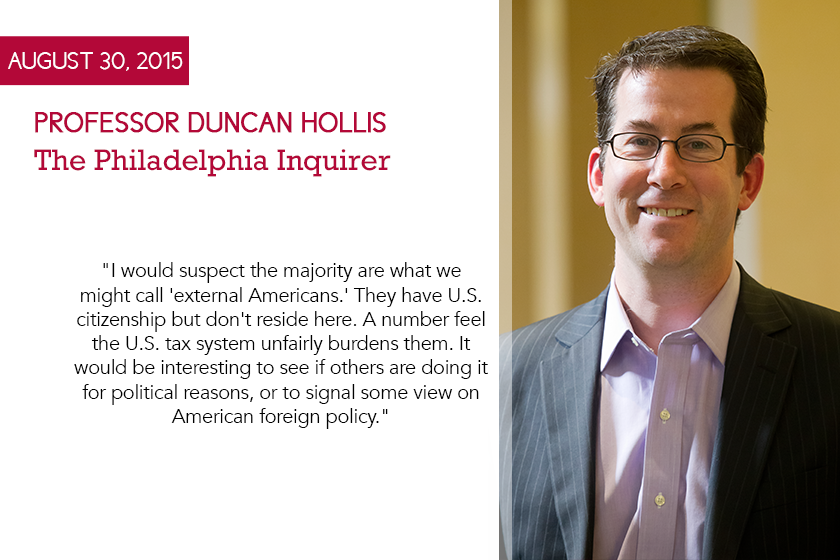
Professors Duncan Hollis and Peter Spiro are quoted in this story by the Philadelphia Inquirer on a new tax law and its potential impact on an especially high number of Americans that are denouncing their citizenship. Read the full story

These have been heady times for those interested in foreign relations law. The last twenty years have seen the field transformed. In the 1970s and 1980s, Vietnam had triggered significant attention on constitutional war powers, but that interest was more political than scholarly. Other foreign relations law issues were debated only at the margins. The Restatement (Third) supplied a largely unchallenged conventional wisdom in the area, even if some of its main points were more aspirational than descriptive. The courts had long been missing in action; though they had been active in the first century or so of the Republic on international law and foreign relations law issues, probably the most important Supreme Court ruling in the area from the second half of the twentieth-century merely served to confirm the judicial timidity. On many of the most important issues of foreign relations, sparse judicial precedents (such as they existed) had no more than oracular application to contemporary questions. Other actors nonetheless managed to achieve constitutional equilibria with little help from the courts or scholars. The …
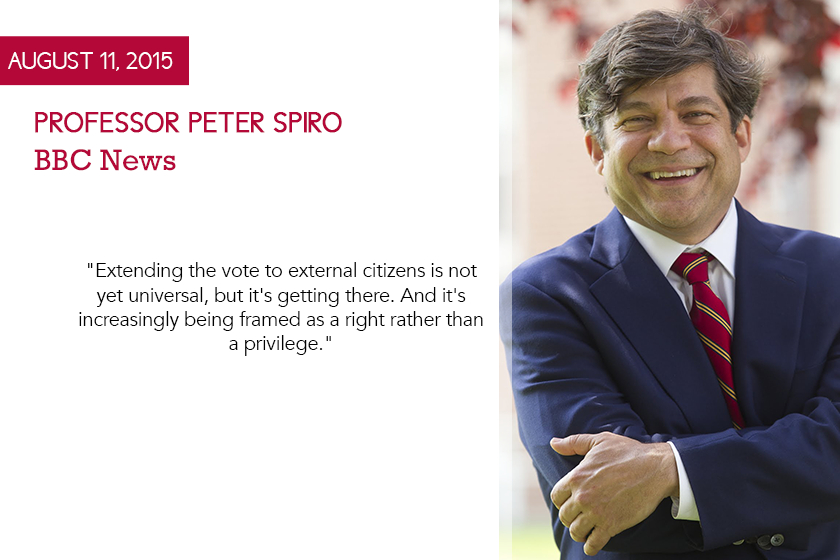
Professor Peter Spiro is quoted in this story by BBC News about an election in Canada and the introduction of new rules that restrict the right of expats to vote. Is that fair? Read the full story

Temple University Beasley School of Law
1719 North Broad Street
Philadelphia, PA 19122
(215) 204-7861
© 2026 Temple University Beasley School of Law.