
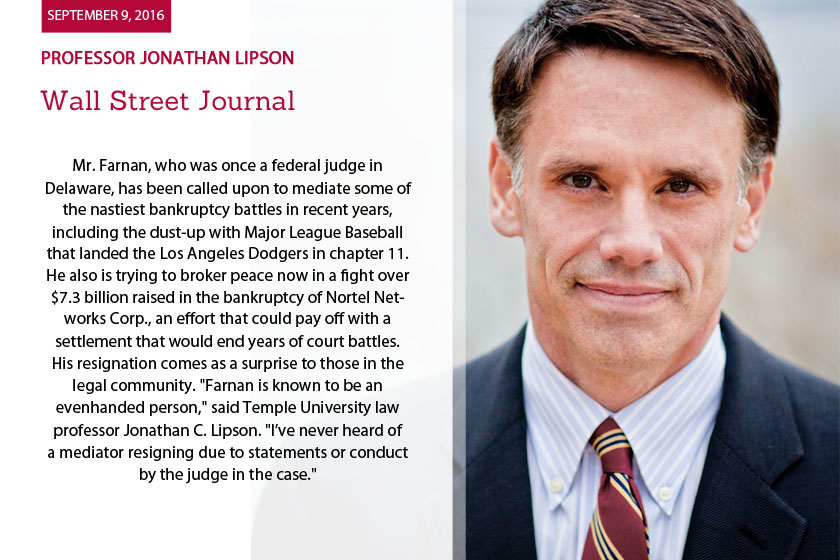
Caesars Bankruptcy Mediator Abruptly Resigns
Professor Jonathan Lipson is quoted in this Wall Street Journal article about the resignation of a respected bankruptcy mediator. Read the Full Article
Professor Jonathan Lipson is quoted in this Wall Street Journal article about the resignation of a respected bankruptcy mediator. Read the Full Article
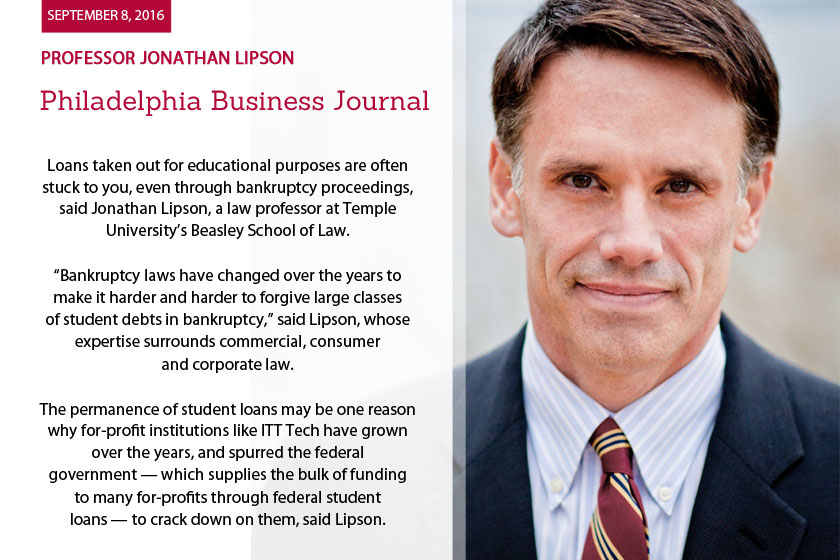
Professor Jonathan Lipson is quoted in this Philadelphia Business Journal article about the closure of ITT Tech. Read the Full Article
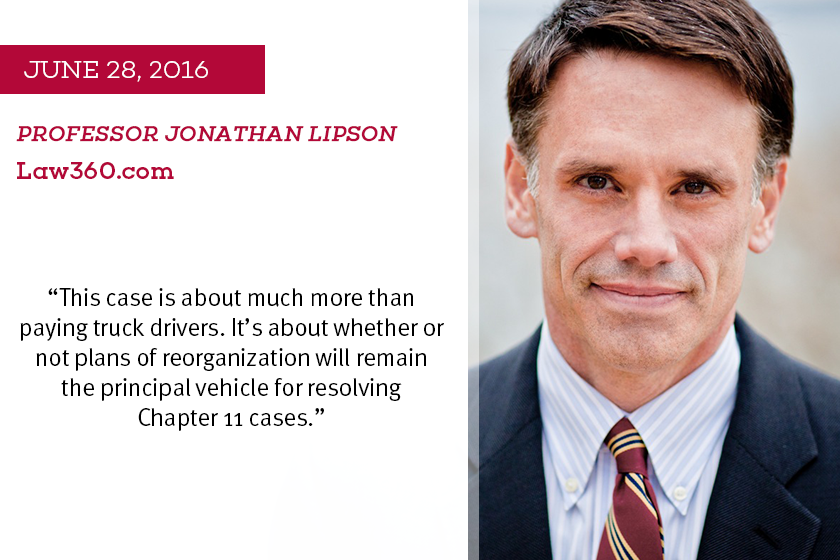
Professor Jonathan Lipson is quoted in this article by Law360 about a bankruptcy case involving Jevic Transportation, Inc. Could this case impact the way debtors and their financial backers structure future Chapter 11 cases? Read the Full Article
The Dodd-Frank financial reforms of 2010 promised to better align risk-reward incentives by, among other things, reducing imprudent securitization (i.e., sales of financial assets) and excessive executive compensation. This would, in turn, promote systemic stability. To assess whether Dodd-Frank’s elaborate rules on securitization and compensation are likely to achieve this goal, we explore the connection between the two empirically. Using a unique dataset covering 1993-2009 — the largest of its kind — we find that securitizing banks (regulated depositaries) on average paid their CEOs twice as much as non-securitizing banks, a finding that is both statistically and economically significant. By contrast, non-bank (industrial) firms that securitized actually paid their CEOs less than non-securitizers. Because securitizing banks performed no better than other firms (non-securitizing banks or industrials), we find evidence of agency cost; because bank-originated securitizations performed especially poorly in the financial crisis, we find evidence of social cost. Our findings have important implications for Dodd-Frank, because its rules on securitization and compensation fail to account for the incentive effects of securitization by banks. Its compensation …
Professor Jonathan Lipson is quoted in this piece by Reuters on a new report due out from a former Watergate prosecutor that could break a deadlock in one of the biggest fights on Wall Street over the bankruptcy of Caesars‘ casino operating unit, Caesars Entertainment Operating. Caesars has proposed injecting $1.5 billion into its operating unit to settle allegations of asset-stripping, and the examiner’s report could show whether or not that amount is fair. But so far junior bondholders have refused to accept Caesars‘ plan, demanding that it inject more money into the bankrupt casino company which would be split into a real estate investment trust and a separate operating unit. Read the Full Story
Professor Jonathan Lipson is quoted in this piece by Reuters on a new turn in the already contentious bankruptcy proceedings between private equity owners of Caesars Entertainment Corp and junior creditors of the company’s operating unit. Read the full story.

Professor Jonathan Lipson is quoted in this story by Reuters on the ongoing bankruptcy estate of Lehman Brothers, the bank that collapsed in 2008 at the height of the financial crisis. Read the full story

Chapter 11 of the Bankruptcy Code presumes that managers will remain in possession and control of a corporate debtor. This presents an obvious agency problem: these same managers may have gotten the company into trouble in the first place. The Bankruptcy Code thus includes checks and balances in the reorganization process, one of which is supposed to be an “examiner,” a private individual appointed to investigate and report on the debtor’s collapse. We study their use in practice. Extending prior research, we find that examiners are exceedingly rare, despite the fact that they should be “mandatory” in large cases ($5 million in debt), and are recommended in all, if “in the interests of creditors.” Using a hand-collected dataset (n=1225) of chapter 11 bankruptcies from 1991-2010, we find that they are sought in less than 9% of cases (104), and appointed in fewer than half of those (48, or 3.9% of the sample). We offer three observations about the under-use of examiners. First, regression modeling shows that the factors that predict when an examiner will be …

Temple University Beasley School of Law
1719 North Broad Street
Philadelphia, PA 19122
(215) 204-7861
© 2026 Temple University Beasley School of Law.