Archives

Reading a Story

Learning From Mistakes: Failing to Story Tell in a Defense Opening

A successful opening statement: Draws in the listener from the first sentences Narrates facts into a story-board or framework that the audience – judge or jury – is familiar and comfortable with Tells that story with less attention to finite details and more to ensuring that the gist is grasped Is persuasive without becoming argumentative Strikes an emotionally resonant chord Leaves the listener desirous of and receptive to confirmation as the evidence unfolds The dilemma is for the defense lawyer, he/she who opens second. If the moving party has indeed set the stage with a compelling narration, the defense must quickly move the listener to a new narrative, a story at least as compelling, familiar and morally satisfying. If this does not occur, there is only one framework and one set of expectations. One author has described this as having and setting a “hook,” much as in fishing: An ordinary opening statement relies upon each juror to supply the motivation to actively listen. A hook is a story device that functions in three important ways: …


Microscope

Unreasonable Certainty: A Call To Abandon “Reasonable Degree of Scientific Testimony” Terminology

The prevailing practice in many jurisdictions, usually compelled by custom rather than law, is to ask a testifying expert whether the opinion proffered or the conclusion drawn is held “to a reasonable degree of scientific certainty.” Yet scientists do not proclaim certainty in their domains; instead they acknowledge and embrace scientific knowledge as an area of change and evolution. And any attempt to define the term fails – how certain is “reasonable” certainty, and how is that measured except as a subjective appraisal rather than a uniform measure within a discipline? The origins of the term also confirm its inutility and inappropriateness in most if not all circumstances. The history of this legal term – and its beginnings with medical experts – was traced in Lewin, The Genesis and Evolution of Legal Uncertainty About “Reasonable Medical Certainty,”, 57 Md. L. Rev. 380 (1988). The emergence of this terminology came from early precedent in regard to expert testimony predicting future consequences such as the need for medical care in years to come or the likely harm …

Film Equipment

Learning Lawyering From Film: “Let Him Have It”

Film, Hollywood and otherwise, draws attention to what it means to be a lawyer, both good and bad. Think Atticus Finch, heroically portrayed by Gregory Peck and of such iconic stature that “the American Film Institute deemed Atticus Finch the number one movie hero of all time…” McMillian. A DIALOGUE COMMEMORATING THE FIFTIETH ANNIVERSARY OF TO KILL A MOCKINGBIRD’S PUBLICATION: ATTICUS FINCH-Christian?, 77 Tenn. L. Rev. 739, 748 (Summer, 2010). But filmed versions of trials, real and imagined, also do much more. As described by Professor Thomas Sullivan: Just as film audiences may learn from filmmakers, the writers, directors, actors, and cinematographers are able to create art that informs lawyers and other actors in the legal system about how film viewers may perceive them. Of course, it is equally true that filmmakers may create wholly unreal pictures of the legal system and the work of lawyers that distort, rather than inform film viewers of this process. SYMPOSIUM: IMAGINING THE CRIMINAL LAW: WHEN CLIENT AND LAWYER MEET IN THE MOVIES*, 25 U. Ark. Little Rock L. Rev. …

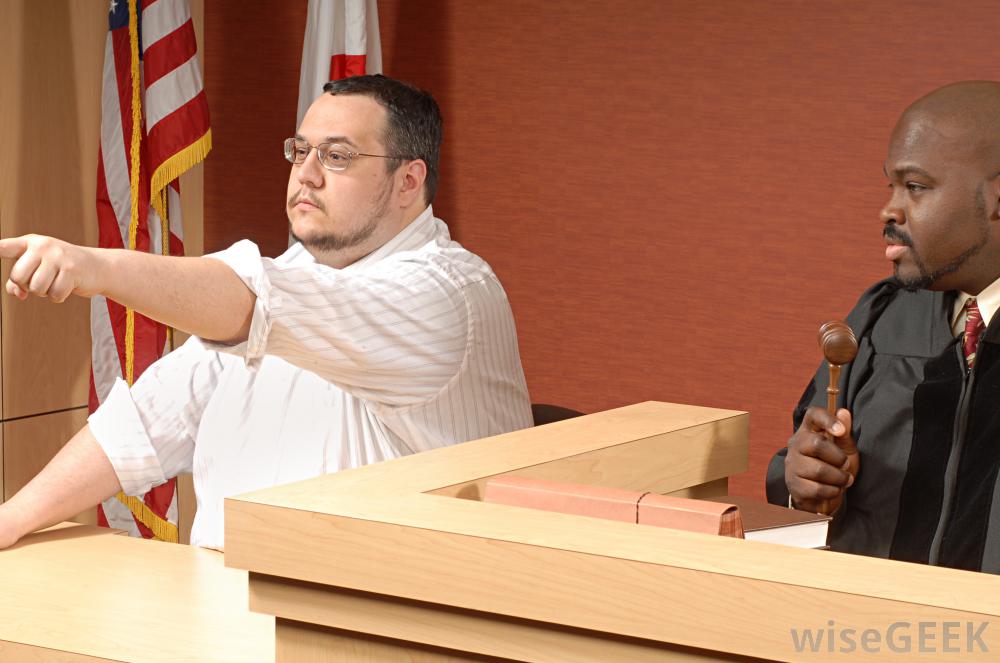
witness pointing at defendant while judge looks on

In-Court Eyewitness Identifications – What Process is “Due” Process?

In any case where identification is at issue, the proverbial drumroll sounds at the crescendo of the witness examination when the prosecution asks “and do you see the person, here in this courtroom, who committed this crime?” And invariably the finger points at the accused. Who else would it be pointed at? The lawyers are known and obvious, the defendant is often a person of color and/or not in the garb of the courtroom professionals, and the courtroom security people are seated nearby. Although there have been rare instances of witnesses pointing to the court reporter or, in one case, the judge, the easy and recurring choice is the obvious one – as if there were an arrow with neon lights shouting “pick him” pointing at the accused. The science is clear – an identification in a courtroom, months or years after an encounter, is much less reliable and probative than one in the immediate aftermath of a crime, a point brought home by the 2014 report IDENTIFYING THE CULPRIT: ASSESSING EYEWITNESS IDENTIFICATION, a survey …

Incorrect Math Equation

Learning From Mistakes: An Imperfect Cross-Examination

“By seeking and blundering we learn” – Goethe “I have not failed. I’ve just found 10,000 ways that won’t work” – Thomas Edison. “A spelling mistake in the DNA of a gene within the brain seems to impair the ability of a person to improve their performance based on knowledge of earlier errors.” – News Story, The Telegraph, 2007. The first two quotes above are inspirational and reflect insight; the third, sadly, seems to fit many lawyers who never recognize their errors and thus persist in their bad habits, especially in the courtroom. It is probably not genetic, but the recurrence argues for a model where we study error, diagnose and diagram it, and then take corrective steps. That is the rationale for this and forthcoming “learning from mistakes” columns. Although there are no hard data to back up this assertion, it is undeniable that poorly constructed cross-examinations occur on a daily basis in courtrooms across this nation. And they are conducted by lawyers with years of experience who, sadly, don’t recognize mistakes and learn …

Police lights in car mirror

If The Driver Had Been White…

As the nation reels after multiple shootings of civilians by police and the subsequent attack on police officers in Dallas, Texas, the words of Minnesota’s Governor that, “Would this have happened if those passengers would have been white? I don’t think it would have,” bear examination. Was he guessing? Condemning a specific police officer? Or simply suggesting that an implicit bias caused the officers to perceive a threat when none was present? The word “bias” needs explication, in particular as “cognitive bias.” “Cognitive bias” does not connote prejudice, an overt and explicit hatred of an individual or group. Instead, it is a psychological term and means that hidden cognitive processes drive what we see and our interpretations of those observations. That racial bias can affect how information is processed cannot be doubted. Study after study has shown that respondents will judge the same scenario differently depending on the name of the suspect; for example, more people were likely to vote for the death penalty when reviewing a case file if the name of the defendant …

Checklist

Do Lawyers Need Checklists to Reduce Error?

Can checklists reduce lawyer error? As they do for doctors or airline pilots or building engineers? Although the focus on this technique has largely been outside of the realm of the legal system, there is enough known to say that its application to lawyers is both necessary and likely to be beneficial. That lawyers do make errors, and errors of grave consequence, cannot be doubted. While it has been written that “[n]o empirical research exists regarding error rates by lawyers, but it is reasonable to assume they make errors as often as doctors[,]’ McClurg, FIGHT CLUB: DOCTORS VS. LAWYERS – A PEACE PLAN GROUNDED IN SELF-INTEREST, 83 Temp. L. Rev. 309, 349 (2011), there are some estimates if not hard data. The late Justice Scalia, when defending death penalty jurisprudence and practice, famously (or perhaps infamously) quoted a New York Times article that “the error rate [in criminal cases is] .027 percent–or, to put it another way, a success rate of 99.973 percent.” Kansas v. Marsh, 548 U.S. 163, 198 (U.S. 2006). Of course, this …

Reptile

Reptiles in the Courtroom

It is remarkable, as one reads cases, to find a series of published ORDERS in which judges tell lawyers to keep the “reptile” theory out of the courtroom. THIS MATTER having come before the Court on Defendant Ruta Obergfell, M.D.’s Motion in Limine #1 to Preclude Impermissible Use of the Reptile Theory, and the Court being fully advised in the premises, IT IS HEREBY ORDERED that Defendant’s Motion is GRANTED. The Plaintiffs and their counsel are hereby barred from arguing or soliciting testimony based on the REPTILE theory including, but not limited to, making arguments or soliciting evidence concerning “community safety or protection,” “public safety or protection,” “safety rules,” “sending a message, “needlessly endangering patients,” or “being guardians of the community.” Hopper v. Ruta, 2013 Colo. Dist. LEXIS 249, *1 (Colo. Dist. Ct. 2013). See also, Pracht v. Saga Freight Logistics, LLC, 2015 U.S. Dist. LEXIS 149775, *4 (W.D.N.C. Oct. 30, 2015)(“ Defendants’ motion to prohibit any Golden Rule argument and/or Reptile Theory questions and argument is GRANTED.”). A less successful attempt occurred more recently, …

Witness Impeachment

Impeaching By Omission

The art of witness impeachment is inextricably bound with the substantive law of evidence. Evidence rules explicitly allow for impeachment of any witness (even one called by the party) and set the procedures for attacking with inconsistencies – the impeaching document need not be shown to the witness, and impeachment must occur with there being some opportunity for the witness to respond and explain. But the rules are silent on at least two critical issues – the why of impeachment, and a definition of what exactly makes a prior statement “inconsistent.” The former question is one answered not in evidence law but in the art and techniques of advocacy. We impeach witnesses to discredit in-court testimony and show them to be liars or mistaken and unreliable. We impeach witnesses to tell or support our own story. We impeach witnesses for the drama it brings to the courtroom and the control it places in the hands of the questioner. As to when a prior statement is “inconsistent,” there is little in terms of a definition beyond inconsistency being in the eye of the advocate/beholder, with a judge viewing …

Man Signing Document

The Prior Statement: If It Isn’t Signed, Is It Impeachment Material?

How should judges approach a case where a testifying witness is going to be impeached, but the impeaching document was not created or adopted by the witness?  What is the rule when the impeaching lawyer has a report by person “B” that avers what testifying witness “A” allegedly said?  The rule, as is developed below, should be to allow the impeachment if the examiner has a good faith reason to believe the statement was made. The impeachment of a witness with her/his own words, showing a change of story that establishes poor memory, unreliability, or outright mendacity, creates excitement in the courtroom.   As explained by Wigmore, “the purpose is to induce the tribunal to discard the one statement because the witness had also made another statement which cannot at the same time be true.”  3A Wigmore, Evidence § 1040 at 1048 (Chadbourn rev. 1970).  See also, United States v. Damatta-Olivera, 37 M.J. 474, 477-478 (C.M.A. 1993).  A Pennsylvania case put it more eloquently: The question of credibility sometimes depends on the slightest inclination of the …