
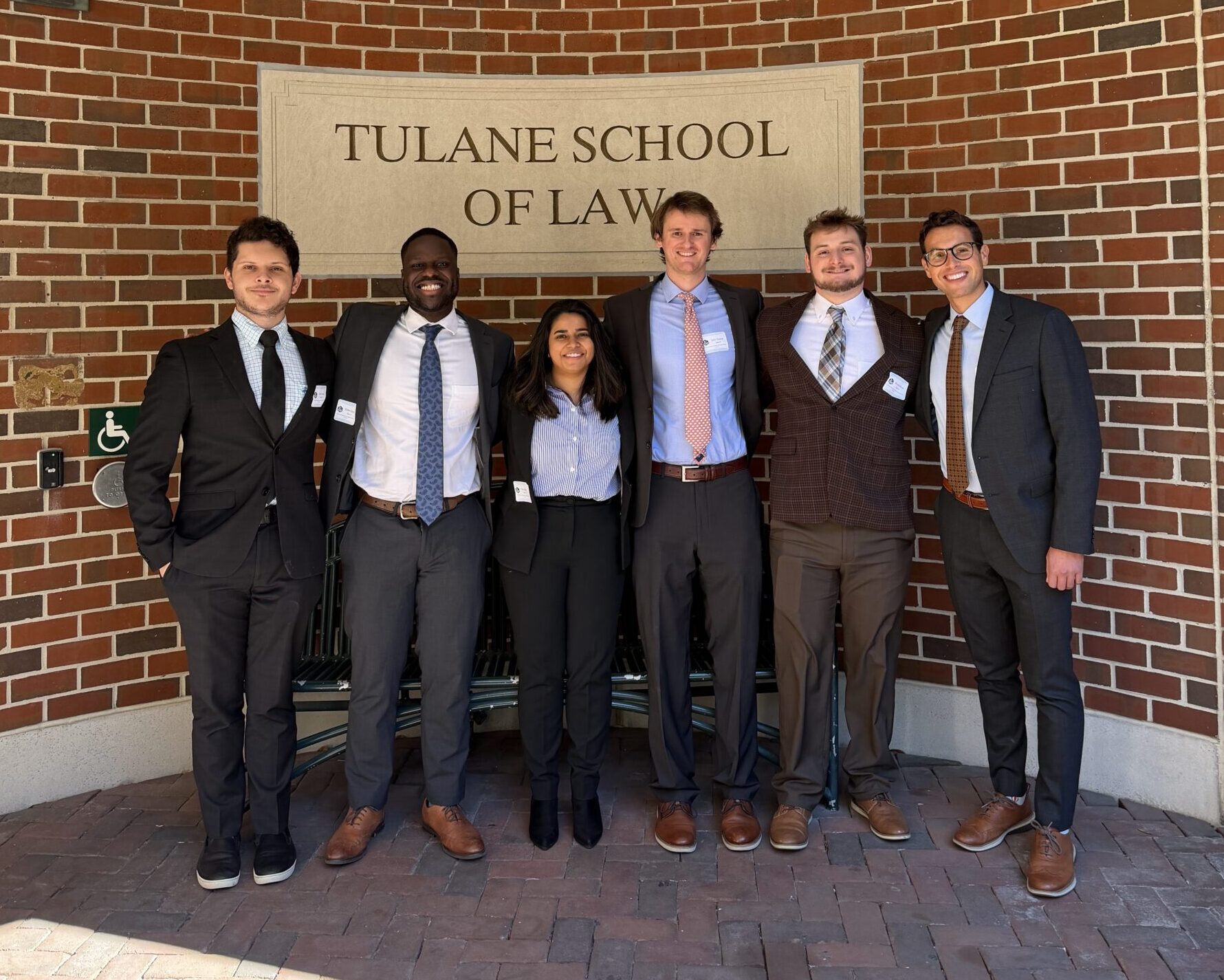
The Sports Law Negotiation Team returned to action last month at the Tulane International Baseball Arbitration Competition (“TIBAC”). If you read my prior article about the Villanova Baseball Filing Day Competition, you already know a little bit about baseball arbitration and the structure of the tournaments that the negotiation team competes in. Villanova’s competition simulated MLB Filing Day, the day by which arbitration-eligible players must reach an agreement with their club on a salary for the upcoming season, or opt to proceed to arbitration. TIBAC is a little bit different – it simulates the baseball arbitration process itself.
The MLB arbitration process begins with each side selecting a filing number, which is the salary they believe the player should be paid for the upcoming season. The parties then create presentations in support of that filing number and deliver them to an arbitrator. The arbitrator must select one of the two proposed salaries – the arbitrator cannot split the difference. In essence, the parties are really arguing that the player should earn above or below the midpoint of the filing numbers. If the player files at $4.5 million and the club files at $3.5 million, the player side will argue that he deserves a salary above $4 million and the club will argue he deserves a salary below that number.
The presentations typically focus on comparing the player’s career and platform year statistics to other players who previously went through arbitration. For example, Temple represented the San Diego Padres against their closer Mason Miller. We compared Miller’s performance to that of David Bednar, who went through arbitration with the Pittsburgh Pirates in 2023. Bednar recorded 39 saves in 42 opportunities and an ERA of 2.00 in his platform year, far exceeding Miller’s 22 saves in 26 opportunities and ERA of 2.63. Bednar had also recorded 61 saves in 70 opportunities and an ERA of 2.90 over his career, compared to Miller’s career 50 saves in 57 opportunities and 2.81 ERA. Given Bednar’s significantly better performance in five of these six statistics, we argued Miller should be compensated less than Bednar, whose arbitration salary was nearly identical to the number that the player side filed at.
In this regard, TIBAC was very similar to Villanova’s competition. However, the presentation format allowed for a continued stream of information and thought, uninterrupted by the opposition. Additionally, using a presentation tool such as Powerpoint allowed competitors to use graphs, tables, and images to illustrate arguments more effectively.
Temple sent two teams to the competition, both of which received high praise and from the assembled judges for their performance. Unfortunately, neither team was able to advance to the second day of the competition, a feat only achieved by eight of the sixty-four teams in attendance. However, it was a tremendous experience and learning opportunity for the negotiation team and we look forward to returning in 2027 with our new insights.
