

Is It Epstein or Is It ChatGPT?
Professor Jules Epstein was persuaded by a colleague to ask ChatGPT to suggest opening lines for a case he had recently argued before the Pennsylvania Supreme Court. The results came as quite a surprise. Read More
Professor Jules Epstein was persuaded by a colleague to ask ChatGPT to suggest opening lines for a case he had recently argued before the Pennsylvania Supreme Court. The results came as quite a surprise. Read More
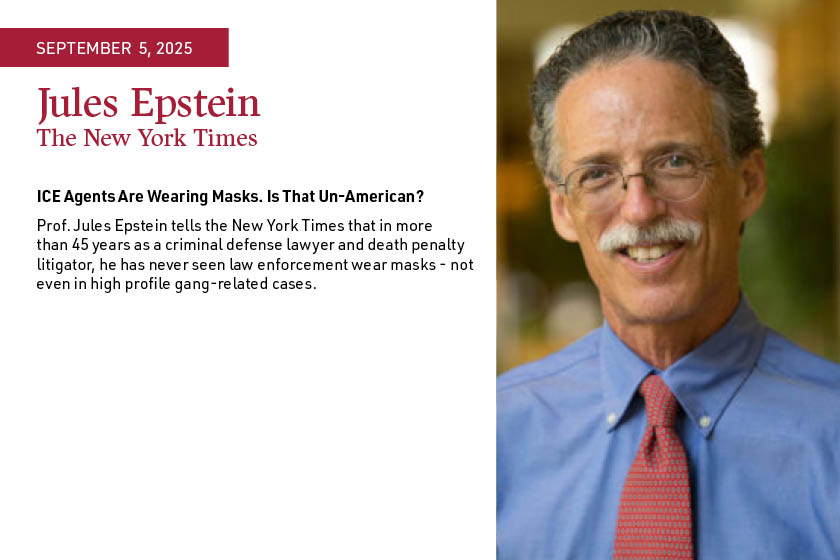
Prof. Jules Epstein tells the New York Times that in more than 45 years as a criminal defense lawyer and death penalty litigator, he has never seen law enforcement wear masks – not even in high profile gang-related cases. Read More
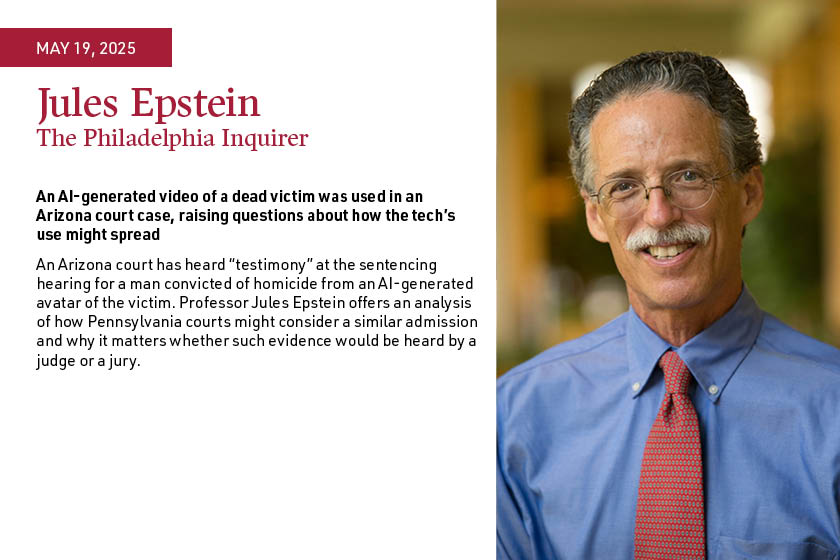
An Al-generated video of a dead victim was used in an Arizona court case, raising questions about how the tech’s use might spread An Arizona court has heard “testimony” at the sentencing hearing for a man convicted of homicide from an Al-generated avatar of the victim. Professor Jules Epstein offers an analysis of how Pennsylvania courts might consider a similar admission and why it matters whether such evidence would be heard by a judge or a jury.
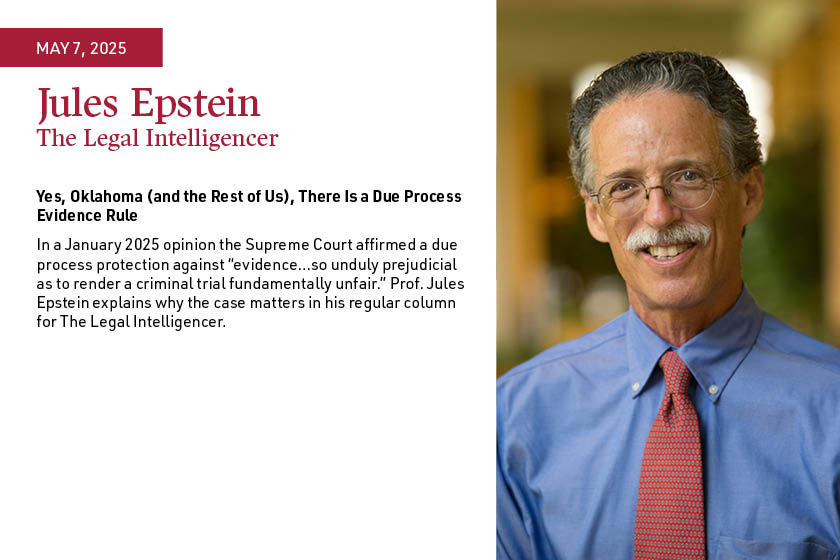
Yes, Oklahoma (and the Rest of Us), There Is a Due Process Evidence Rule In a January 2025 opinion the Supreme Court affirmed a due process protection against “evidence…so unduly prejudicial as to render a criminal trial fundamentally unfair.” Prof. Jules Epstein explains why the case matters in his regular column for The Legal Intelligencer.
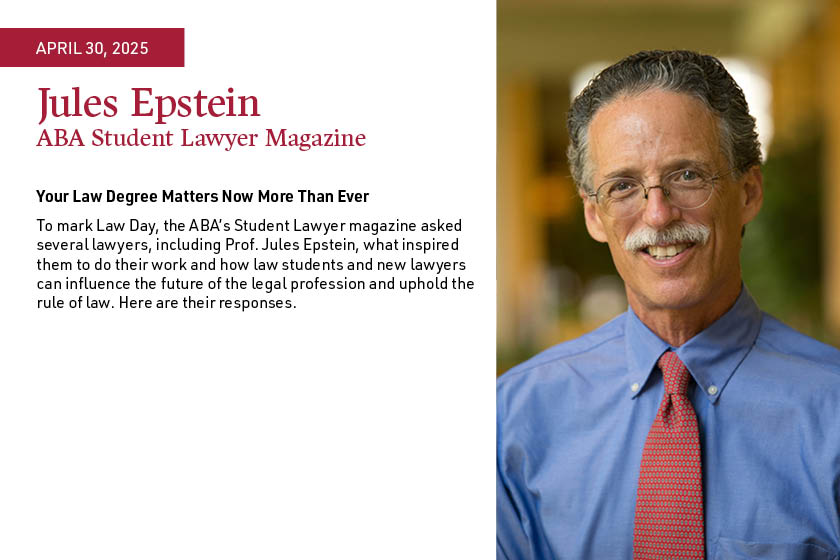
To mark Law Day, the ABA’s Student Lawyer magazine asked several lawyers, including Prof. Jules Epstein, what inspired them to do their work and how law students and new lawyers can influence the future of the legal profession and uphold the rule of law. Here are their responses.
A Montgomery County man claiming self-defense has been acquitted of homicide after 10 months in jail. Prof. Jules Epstein questions the DA’s charging decision in the case. “If self-defense is a gray area in a case, it may be reasonable to bring some criminal charges,” Epstein said. “But calling it first-degree murder? Putting a person at risk of life in jail? Making it harder to get bail? All of those seem to be wrong decisions.”
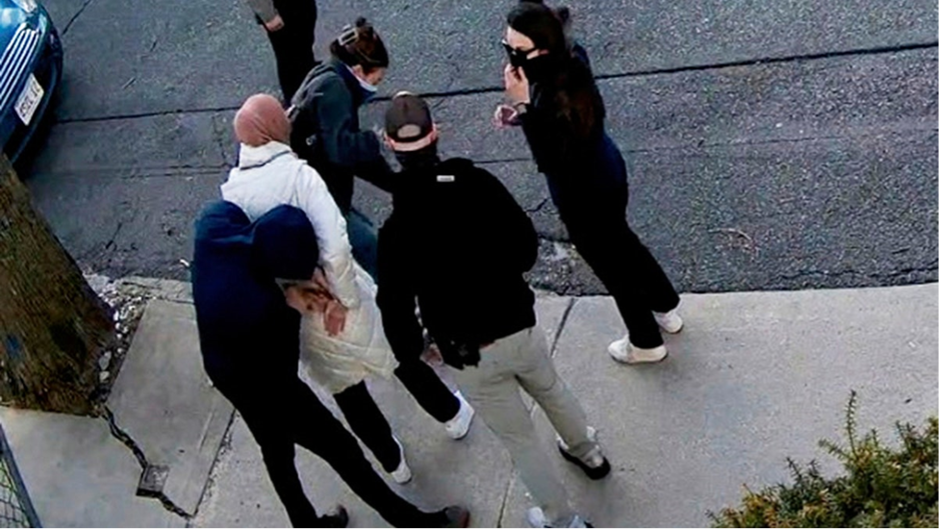
Other than the Lone Ranger and Zorro and “superheroes,” the ‘good guys’ never wear masks. Then why are ICE agents masked and is it right to be disturbed by that choice? Masking of police officers is not an American tradition. Far from it – police wear badges with numbers and name tags, and travel in marked cars. We even disclose names of police charged with misconduct despite fears about whether they will have protests near their homes. And masks have been banned in state after state, going back to at least 1845, when New York prohibited them because they permitted insurrectionists to go unpunished, and later in response to the Ku Klux Klan. How were masks used beyond hiding identity? As one court explained, by 1867 “masked Klan members had assumed the practice of ‘night riding,’ making nocturnal visits to the dwellings of blacks in order to harass and intimidate.” Church of the Am. Knights of the KKK v. Kerik, 356 F.3d 197, 200 (2nd Cir. 2004). Beyond masks going against tradition, they intimidate not …
Lawyers: Uncle Sam Needs You! In commentary for the Legal Intelligencer, Prof. Jules Epstein and co-authors Ellen Brotman and Amy J. Coco raise the alarm about threats to the rule of law and issue a call for unity in defense of the profession, the judiciary, and the Constitution.
JD Vance Fails Constitutional Law If Vice President Vance was graded on his knowledge and application of constitutional law, writes Prof. Jules Epstein, he would come up short.
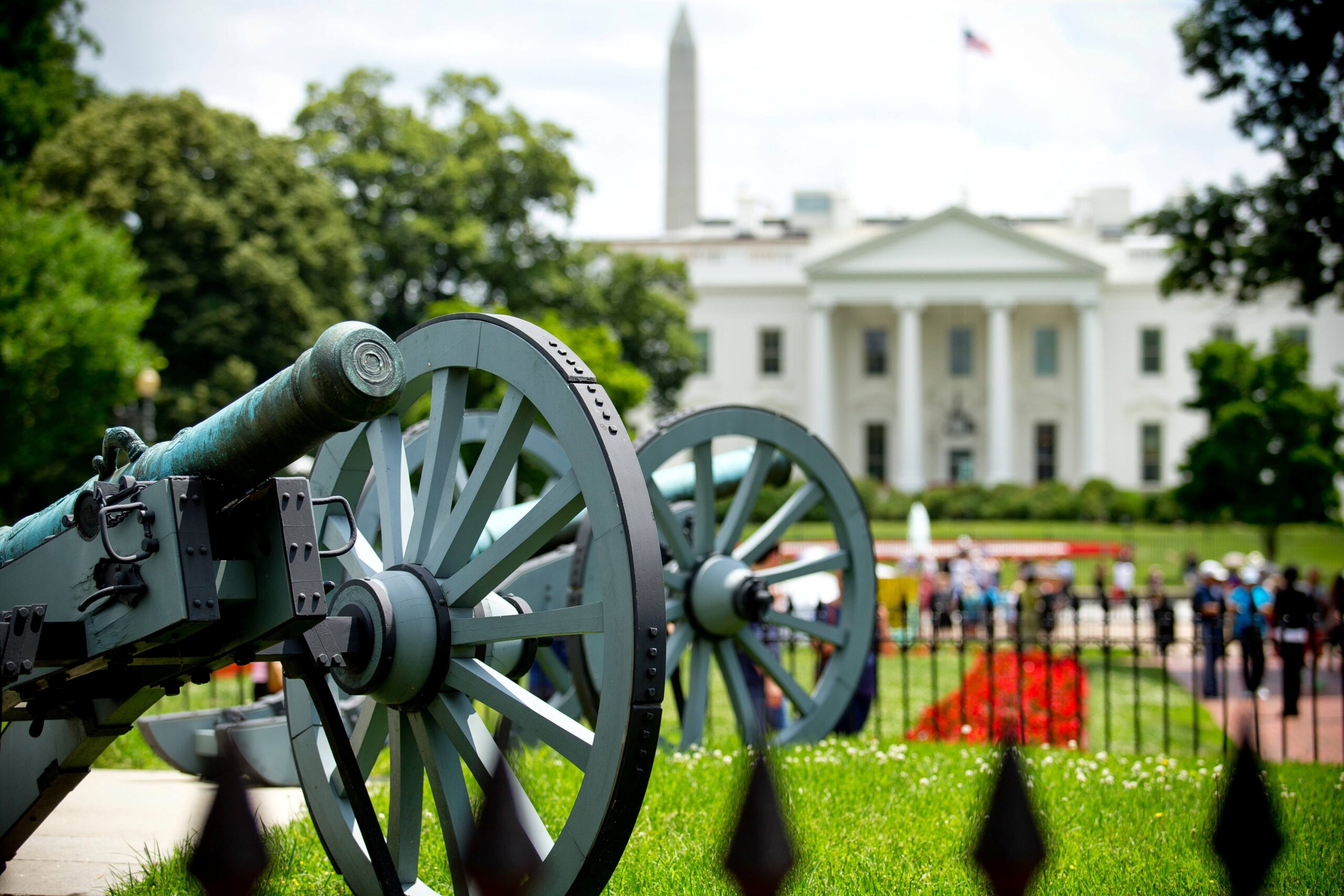
Shakespeare’s Dick the Butcher, in the play Henry VI, uttered the oft-quoted words “The first thing we do, let’s kill all the lawyers.” Shakespeare’s intent with these words has been debated, but one interpretation is significant. “Shakespeare insightfully realized that disposing of lawyers is a step in the direction of a totalitarian form of government.” Walters v. Nat’l Ass’n of Radiation Survivors, 473 U.S. 305, 371 (1985) (Stevens, J. dissenting). The Trump script is different but at least as pernicious – ‘the first thing we do, we frighten [indeed threaten] lawyers who challenge the administration’s authority’. What brought this on? Jack Smith, former special counsel prosecuting Mr. Trump, sought legal services after resigning. A law firm offered that assistance at no cost. When that became public, the attack on lawyers commenced with a fury. Wielding power from the Oval Office, the President issued a memorandum against that firm, Covington and Burling, stripping security clearances from some of its attorneys and directing “all agencies to review all Government contracts with Covington & Burling LLP.” Put more …

Temple University Beasley School of Law
1719 North Broad Street
Philadelphia, PA 19122
(215) 204-7861
© 2026 Temple University Beasley School of Law.