

Temple Law Professor Weighs In On Supreme Court Nomination
Professor Bob Reinstein talked with CBS Philly about new Supreme Court nominee Merrick Garland and a history of late nominations that goes back to the Founding Fathers. Read the Full Story
Professor Bob Reinstein talked with CBS Philly about new Supreme Court nominee Merrick Garland and a history of late nominations that goes back to the Founding Fathers. Read the Full Story

For most people, pizza, pasta, and Prada are the only reasons they need to visit the Eternal City. As a law student, however, we must give careful consideration to how we spend our time and money at this critical time in our careers. Almost a year after enrolling in the Rome Program, I look back on those warm, sunny days and appreciate not only the cultural and culinary aspects of the trip, but also the academic and educational aspects that enriched my law school experience. Take classes you wouldn’t otherwise take Between bar courses, practicums, and writing requirements, six semesters is just not enough time to delve into every appealing legal topic. The Rome Program gives you the opportunity to sneak in 3-5 credits worth of classes you might not otherwise take. For students interested in international law, Rome is an opportunity to complete prioritized classes faster than they would otherwise. I would have graduated without having taken a single international law class had it not been for Rome. This means I would have left …

Throughout my education, I have always had a strong inclination towards reading and research. I was encouraged to embrace my willingness to delve into a new book or use spare time to document my ideas. In college, I took advantage of the opportunity to take classes that involved literature and ethnic studies, environmental issues, and language translation. I wrote papers on the Truth and Reconciliation Commission of post-South African Apartheid and the challenges and prospects of openness and democracy in Cuba. Other classes required formal papers in Spanish or gave me the opportunity to reach back to translations of philosophy from Plato. Books that shaped my life included a memoir and autobiography by President Barack Obama. These books left me questioning policy at the local level, and I found courage and authentic perspectives on community development through its pages. My interest in policy led me to attend college at The George Washington University in Washington, D.C. There, I conducted guided research on water resources and interned at the U.S. Environmental Protection Agency (EPA) Office of …

I am a somewhat atypical Temple Law Student. Whereas most law students simply move from their 1L year to 2L year, I decided to move to Milan, Italy for my fall semester to study international intellectual property, human rights, and the legal system of the European Union. I then decided to spend my 2L spring semester at Temple’s campus in Tokyo, Japan, where I’m gaining insight into the legal systems of east Asia. In total, I will be studying abroad for eight months. Making the decision to study abroad, especially for two semesters, is a big commitment. Below, I’ve shared the questions I asked myself before making the decision to go international. If you’re thinking of studying abroad in law school, these questions are a good place to start. Question One: Are you looking to study abroad because it will be a useful tool in your law school toolbox, or because you just want to travel the world? Prior to law school, I moved from place to place, working as a system engineer for various branches and …

There are many reasons to pursue a public interest internship, especially in your 1L summer. For students who are strongly considering careers in the field, it is essential to start building experiences and connections now. Beyond that, public interest jobs often involve experience with real clients, can present great research and writing opportunities, offer a chance to fulfill the public and pro bono service ideals of our profession, and act as a reminder that you came to law school to solve problems for real people, not to take tests and get grades. Many students find it meaningful and fulfilling to have the experience of assisting people who would otherwise find it challenging to navigate the legal system with crucial issues in their lives, or to contribute to making our government and laws work better for the people they affect. But in order to get one of these jobs, you have to act now. PIPS Fair Why? Most public interest employers hire their summer interns now, in late January and February. Many of those hires happen …

Sometimes we put so much focus on finishing something, that we don’t give credence or attention to how we began. We look at the result, how we did, what we have to show for it, and don’t respect the first steps we took to make it to the end. As law students, it’s easy to use your grades as a measurement of your experience during a semester, but really the path to those grades started fourteen weeks before the exam. And now, with the spring semester just beginning, you have the opportunity to start off as strong as you mean to end. What do I mean by that? In order to do well on exams, you must approach the entire semester in a manner that will lead to success in the end. If doing well on exams takes hard-work, grit, and determination, then you must put hard-work, grit, and determination into your everyday routine. It’s early in the semester and exams seem far away, but that doesn’t mean you should take it easy. Take advantage of …
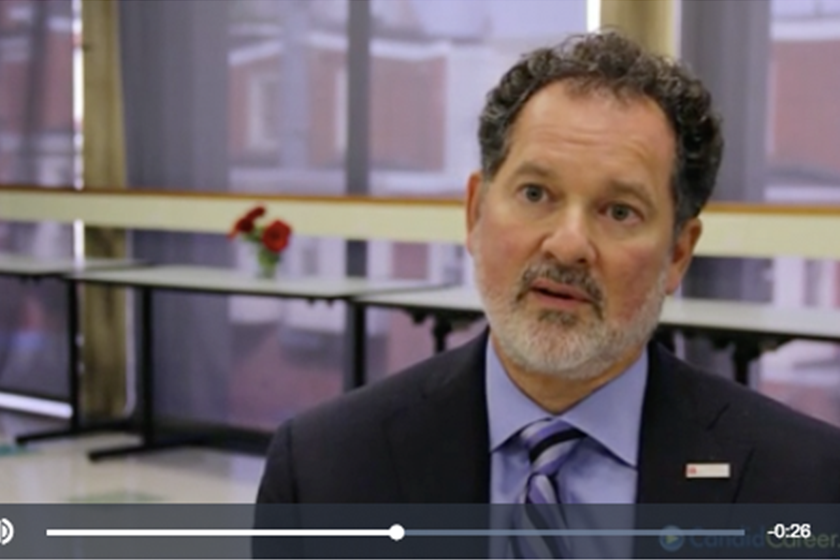
Grant Rawdin (LAW ’87), Founder and CEO of Wescott Financial Advisory Group LLC, describes why he looks at students’ Linkedin page and what he’s really looking for in a profile.

I still have a long road to graduation in front of me, but with my first semester as a 1LE completed, I feel like I’ve learned a thing or two about being a student in Temple Law’s evening program that can help you if you’re thinking of taking on the challenge.

The thing about lawyers is that we fight for real human beings. By being advocates, we can alleviate someone’s worries, relieve someone’s stress, we can give. Every lawyer does it in a different way – whether through public interest work, through well-informed advice to a client, or through competence in litigation. We all give.
It’s important to recognize that this is a major part of this field. It is why so many lawyers do pro-bono work – not because they are encouraged or obligated to, but because it is rewarding to give back to the community that we live in.

I don’t relish my student’s traumatic experiences. I am happy, however, that they are happening with me there to support them. Perhaps I should be a little less overtly honest about it with my students. As they came in over the last few weeks to relay some of their traumatic experiences to me, maybe I should not have moved so quickly to tell my students how much I thought they were learning from it and instead commiserated more on how bad it must be to experience clients’ trauma for the first time. One student, on meeting his SSI client for the first time, had her tell him it wasn’t worth living once she was denied benefits and that she had considered killing herself over the case. Another student went before an ALJ quite convinced that her severely mentally ill client should win only to have the ALJ badger her and the client about drug use that seemed truly irrelevant. Like many clinicians, I have sent students to see dying clients, had clients insult and run …

Temple University Beasley School of Law
1719 North Broad Street
Philadelphia, PA 19122
(215) 204-7861
© 2026 Temple University Beasley School of Law.