Archives

Law library in Klein Hall from the view point of the top floor looking down.

1L Grades Have Dropped: Now What?

You made it through half of your 1L year, you (hopefully) had some rest and rejuvenation away from law school, and now we have ruined it all by posting your grades right before you had to jump into your second semester. Sorry about that. Now that you have had a few days to freak out, look at your grades, freak out again, and sleep on it a couple of nights, here are a few thoughts from someone who has seen a lot of students go through this. Most importantly, as I tell my students every fall after they take the exam, law school exams do not indicate how smart you are or how good a lawyer you are going to be. Law school exams evaluate specific skills that you are still very much in the process of learning. If you had me for Contracts, that grade tells you how you did on issue-spotter essays about contracts and Muppets on one day in December. I know that your grade feels incredibly consequential, but it is one …
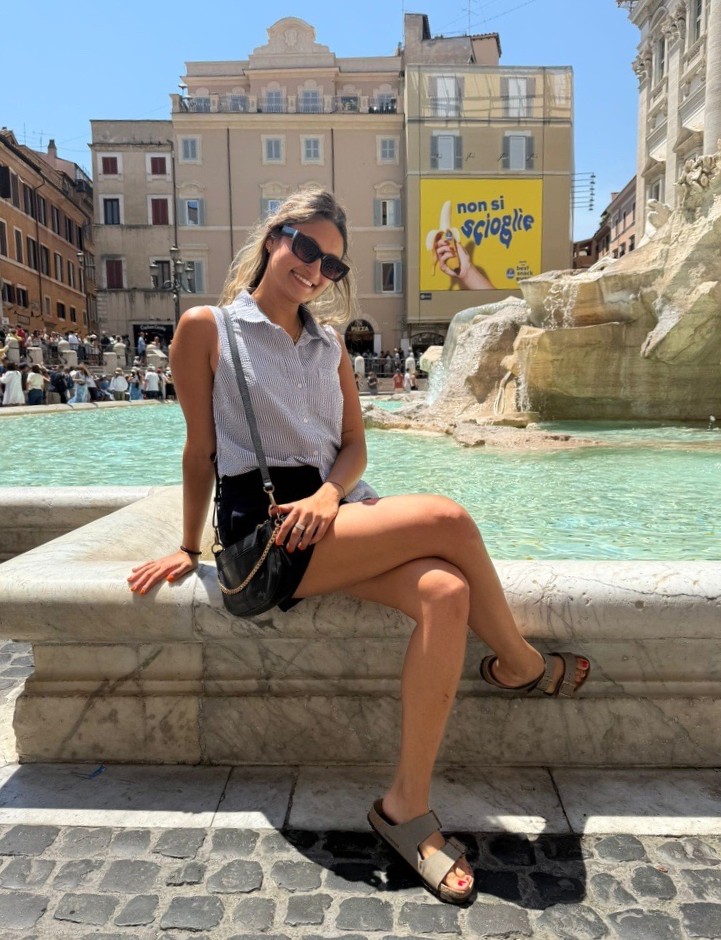
Picture of Atoosa Haghani in Rome Study Aboard Law Semester

From the Trevi Fountain to Trade Law: Finding My Future in Rome

When I began law school, I wasn’t entirely sure which area of the legal field I wanted to pursue. That changed the summer after my 1L year, when I was accepted into Temple Law’s Rome Program. There, I took three courses (earning 5 credits) and interned at a well-known international law firm. The combination of studying international law in the heart of Rome and working alongside practicing attorneys gave me both unforgettable experiences and a clear sense of direction for my career.   Living just twenty minutes from campus near Piazza di Spagna felt like the best kind of luck. Each morning, I passed Versace and Valentino on my way to class, and each evening I returned home to classmates who quickly became like family. I also grew close with law students from around the world, expanding my professional network in ways I couldn’t have imagined. Outside of school, I experienced the city the way it should be experienced—vintage shopping on Sundays at the Mercato, dancing with local artists in Trastevere, and even getting my own …

Your Bar of Chocolate or Your Cup of Coffee May Be Causing Problems Somewhere: Deforestation & International Law

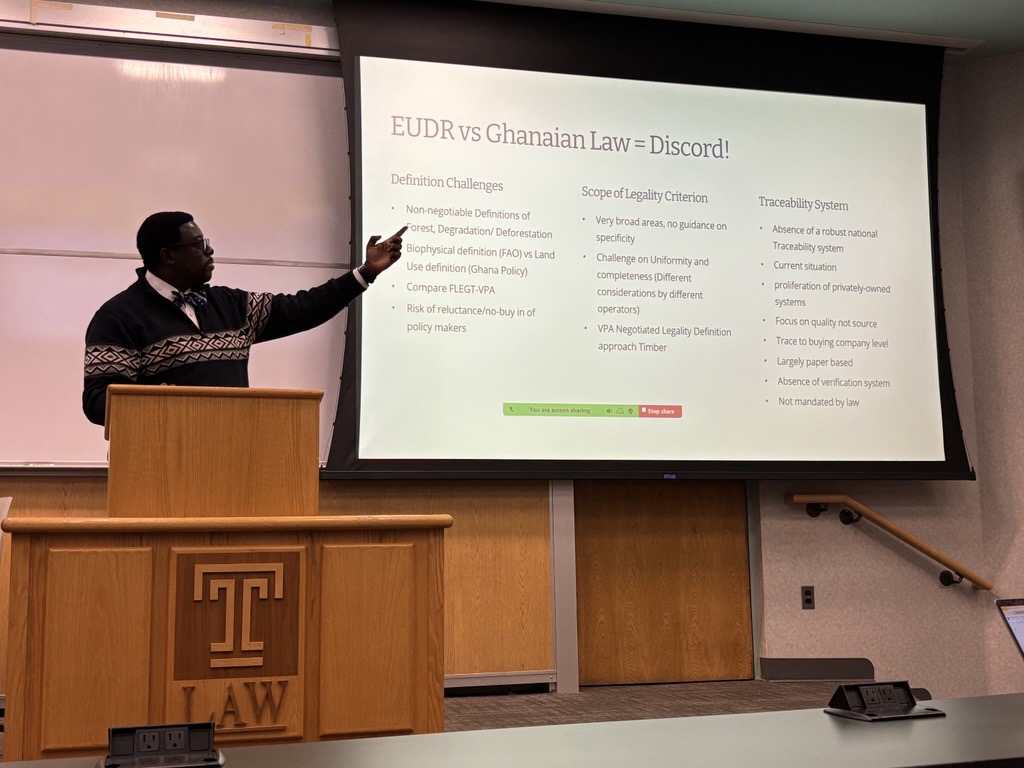
On April 9, 2025, Professor Clement Kojo Akapame, a visiting scholar from the Ghana Institute of Management and Public Administration (GIMPA), presented a lecture titled “Your Bar of Chocolate or Your Cup of Coffee May Be Causing Problems Somewhere: Deforestation & International Law” to Temple Law students. Many students from GIMPA, as well as GIMPA’s Dean Kwaku Agyeman-Budu, also attended the lecture virtually by Zoom. The lecture, organized by Temple Law School’s International Legal Society, summarized the research that Professor Akapame has been conducting for nearly the past year, since his arrival on Temple’s campus in August 2024. Professor Akapame is a legal academic and thought leader who specializes in sustainability standards for the commercial trade of forest risk commodities, as well as forestry law and policy on environmental conservation. He is also a Partner at Taylore Crabbe Barristers and Solicitors, where he leads the firm’s Corporate Commercial and Consultancy practice team. During his lecture, Akapame identified issues of deforestation due to the exploitation of cocoa bean farmers by large companies in the chocolate industry, …

How the Tech Justice Clinic Opened Doors I Had Previously Closed

Long before law school, I had aspirations of pursuing a PhD in Media Studies. After writing a Bachelor’s thesis on diva worship among gay men on Twitter (yes––it was Twitter when I wrote it!), I moved to Amsterdam where I wrote a Master’s thesis on Chechen police violence enacted against gay men via Grindr (a gay dating app). I had, and still have, big questions surrounding privatized media environments, freedom of expression, internet sovereignty, surveillance and control, and the interplay between physical bodies and their digital counterparts. I was heading down the academic pathway when Covid hit and changed the trajectory of my career.   Years later, I found myself in law school. I entered law school extremely skeptical of the field––a field that has a reputation for being rigid, limiting, and unyielding. I was convinced that this critical media training I went through would necessarily be cast aside in pursuit of more “concrete,” legal analysis. To be sure, my background in critical media studies did not come up much during my 1L year. But in …

Temple University Beasley School of Law's Professor Margaret deGuzman sitting on the judge of the Residual Mechanism for International Criminal Tribunals.

Are Juries Worth the Effort? A View from the International Bench

At this year’s Edward Ross Lecture in Litigation, the Honorable Rebecca Pallmeyer, Chief Judge of the United States District Court for the Northern District of Illinois, addressed the important and controversial topic: are jury trials worth the effort? Judge Pallmeyer’s answer was an unequivocal “yes.” She argued that juries are not merely useful tools for adjudicating cases, they are integral to the legitimacy of the American legal system. According to the Chief Judge, jury trials are one of the reasons that Americans respect the law. In her view, juries are often perceived as more impartial than judges, bringing diversity of experiences and perspectives to the resolution of cases. She emphasized that participation in the jury system promotes confidence in the system’s fairness.  Judge Pallmeyer’s views comport with conventional wisdom about the importance of juries. As every American knows, jury service is an essential duty of citizenship. According to a Pew Research Center Survey, two-thirds of U.S. adults consider jury service integral to good citizenship. District Court Judge Zach Zouhary begins trials by telling jurors that …

The Trump Indictment: What’s Happened and What’s Next

A New York grand jury has indicted former President Donald Trump on fraud charges, marking the first time in US history that a former or current president has faced criminal charges. Professor Lauren Ouziel, a former federal prosecutor who teaches and writes about criminal law and criminal procedure at Temple Law, explains what’s happened so far and what’s likely to happen next. Temple Law School: How do indictments work? Lauren Ouziel: A grand jury, which is a group of randomly selected people (in New York, the group is composed of 23 people), meets to hear the testimony of witnesses and review any documentary evidence. At the close of the presentation of evidence, the prosecutors will usually then present the grand jury with a proposed indictment containing the charges against the defendant. The grand jury then deliberates and considers whether there is probable cause to believe the defendant committed the crimes charged in the indictment. The grand jury then votes, and if at least 12 of the grand jurors vote in favor, the indictment is issued. …

Temple Alumni Host International Students for Thanksgiving

Thanksgiving celebration with Brooke Banville FOX ’09 This Thanksgiving, Temple alumni opened their homes—and hearts—to students in the Master of Laws (LLM) for Foreign-Trained Lawyers program. Joana Gaizelyte-Lacy JD ’09, Brooke Banville FOX ’09, and Temple friend Tricia Neff each hosted international LLM students at their homes to experience the quintessential American holiday. Thunvath Thorng LLM ’23, reflected on his visit with Joana Gaizeyte-Lacy: Frankly, it was a delightful experience to have a Thanksgiving Feast with a local Philadelphia family, especially a Temple Law alum. This American unifying holiday is where family members gather, indulge in a wide range of cuisines, interactively exchange stories, laugh, and more. This exquisite and well-decorated dinner celebration allows me to realistically see and dive deep into American culture and tradition. I sincerely appreciate the alum’s effort in hosting this event, and hopefully, there will be more for next year, and even years ahead. It surely is one of my most memorable nights in America, as an LL.M. student at Temple. Along with Thunvath, other international LLM students spent Thanksgiving …

Why You Should Be Learning More About Compliance & Ethics Right Now

What is compliance & ethics? As a law student, it is impossible to know every legal career path, and compliance and ethics is one path that may seem particularly abstract. As one NYU law professor explains, “The compliance function consists of efforts organizations undertake to ensure that employees and others associated with the firm do not violate applicable rules, regulations or norms. It is a form of internalized law enforcement which, if it functions effectively, can substitute for much (although not all) of the enforcement activities provided by the state.” [1] Put simply, employees in a compliance and ethics role at different organizations work to ensure that their organization and its constituents comply with the applicable laws and regulations. This may entail establishing and enforcing corporate policies to address federal and state laws, holding compliance training sessions for employees at all levels within the organization, and creating an infrastructure for anonymous reporting of violations. Although such a process may resemble what in-house attorneys do, companies are increasingly compartmentalizing the compliance and ethics function into its …

More Than a Seat at the Table

More Than a Seat at the Table – Meaningful Multistakeholder Engagement yet to be Seen at UN Cybercrime Treaty Negotiations The Colonial Pipeline is one of the largest oil pipelines in the United States, spanning over 5,500 miles and supplying nearly half the fuel for the East Coast. On May 6, 2021, Eastern European hacker group DarkSide initiated a ransomware attack on the pipeline’s digital system, demanding 75 Bitcoin while holding the company’s data hostage. In response to the attack, Colonial temporarily halted all pipeline operations, causing jet fuel shortages for airlines, and leading to consumer panic buying and spiking gas prices. The Colonial Pipeline attack was not an isolated incident, ransomware attacks are rising in frequency and scope and have targeted critical infrastructure like healthcare and education systems. Information and communication technologies (ICTs) stretch across political borders, connecting societies like never before, and can increase opportunities for social and economic benefits. The COVID-19 pandemic accelerated dependence on digital infrastructure in myriad ways, facilitating drastic changes in work, education, and industry patterns. While digital connectivity …

Putting Lawyering Skills Into Practice Through Community Legal Services’ (CLS) Youth Justice Project

This summer, I worked with Community Legal Services’ (CLS) Youth Justice Project (YJP) under the supervision of Temple Law alum Tracie Johnson LAW ’18. YJP works with young people across the range of legal needs they experience. This allowed me to learn about and work on a variety of issues, from helping clients get probation fees waived to researching the legal standard for “recklessness.” What made the work particularly impactful was getting to help clients solve their individual legal problems while also working towards structural change to address the injustices at the heart of those needs. One of my main assignments was representing a client in a hearing to determine whether they could continue to receive Supplemental Security Income (SSI) benefits. This allowed me to put crucial lawyering skills such as client interviewing, analyzing records, case strategy, and oral advocacy into practice. However, this work went beyond addressing one client’s needs. I also assisted with a roundtable that allowed community organizations who help people apply for SSI benefits to share their experiences directly with congresspeople …