Archives

Clarence Gideon

Gideon’s Heritage Comes to Pennsylvania: Toward A Metric For The Right To Counsel

Everyone should know the story of Clarence Gideon.  Charged with Burglary, he asked for but was denied a lawyer: The Defendant: Your Honor, I said: I request this court to appoint Counsel to represent me in this trial. The Court: Mr. Gideon, I am sorry, but I cannot appoint Counsel to represent you in this case. Under the laws of the state of Florida, the only time the Court can appoint Counsel to represent a Defendant is when that person is charged with a capital offense. I am sorry, but I will have to deny your request to appoint Counsel to represent you in this case. The rest, as they say, is history.  With a self-prepared petition on Florida’s prison paperwork, Gideon brought the Supreme Court to rule that “in our adversary system of criminal justice, any person haled into court, who is too poor to hire a lawyer, cannot be assured a fair trial unless counsel is provided for him.” That was 1963.  This year, for the first time, the Pennsylvania Supreme Court had …

Police lights in car mirror

If The Driver Had Been White…

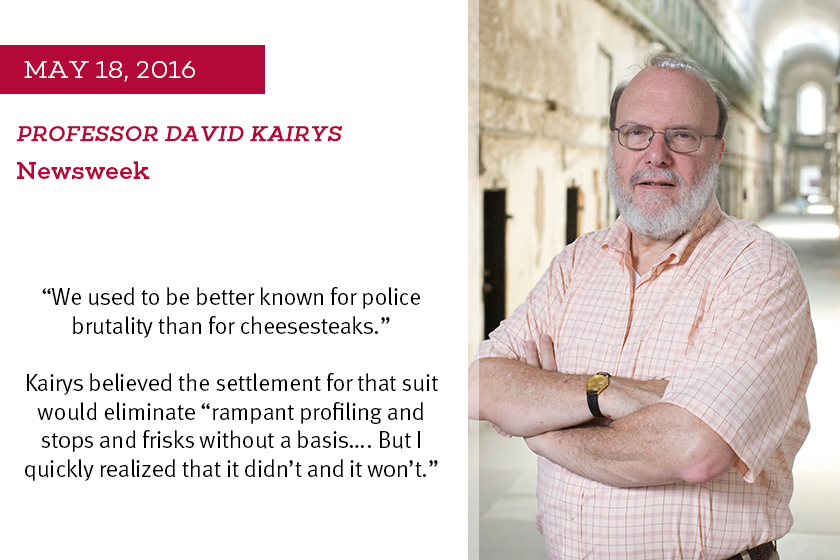
As the nation reels after multiple shootings of civilians by police and the subsequent attack on police officers in Dallas, Texas, the words of Minnesota’s Governor that, “Would this have happened if those passengers would have been white? I don’t think it would have,” bear examination. Was he guessing? Condemning a specific police officer? Or simply suggesting that an implicit bias caused the officers to perceive a threat when none was present? The word “bias” needs explication, in particular as “cognitive bias.” “Cognitive bias” does not connote prejudice, an overt and explicit hatred of an individual or group. Instead, it is a psychological term and means that hidden cognitive processes drive what we see and our interpretations of those observations. That racial bias can affect how information is processed cannot be doubted. Study after study has shown that respondents will judge the same scenario differently depending on the name of the suspect; for example, more people were likely to vote for the death penalty when reviewing a case file if the name of the defendant …

Courtroom

What is a Federal Clerkship?

Unless you’re a lawyer or a law student, you might not know what a law clerk does. When I tell people that I’m a law clerk for a federal judge, sometimes they nod, smile, or just change the subject. More often than not, however, they ask, “What does that even mean?” Once I explain, many then ask, “Do you get paid for that?” I do indeed get paid, but the benefits of clerking stretch far beyond my government paycheck. Broadly speaking, law clerks exist to ensure that the judges they work for are as informed as possible before making decisions. They do so by researching the law involved in each case and writing memos analyzing the facts of that case and the litigants’ arguments in light of this law. They also attend trials and hearings, where they mostly observe and take careful notes so that they can later discuss with their judges any unexpected issues that arose during these proceedings. “Through [my clerkship] experiences, I not only bolstered my abilities to analyze and explain complicated …

Philadelphia Skyline from Fitler Square

My Philly Neighborhood: Fitler Square

I grew up in Fitler Square, a small, quaint neighborhood in the southwest corner of Center City. The neighborhood’s charm is defined by its Victorian-era, 19th and 20th century row homes and its close proximity to Rittenhouse Square, Taney Park, and other Center City neighborhoods. The best part about Fitler Square is its diversity and exuberance; the neighborhood is comprised of families, young professionals, students, and empty nesters. I grew up loving the neighborhood, and I’ve never strayed too far. I returned to the neighborhood when I started law school and I could not be happier with my decision.

Klein Hall

Four Things To Consider When Transferring Law Schools

Transferring law schools in your second year can be a tough transition. When I transferred from Brooklyn Law School to Temple Law in the fall of 2015, I knew I was in for a challenge. The following are things that I experienced when transferring and ways that I have combatted them. You’ll lose social connections Transfers start out at a social disadvantage. We miss out on the connections our new classmates made in their first year, which are crucial connections for law school and beyond. I had to work extra hard to find a study group and professors who could mentor me and write recommendations on my behalf. (It was a condition at Brooklyn Law School that if I transferred, I could not contact my first-year professors for recommendations.) My biggest fear with transferring was that I was going to be a loner. This fear quickly dissipated as I met a couple of students who welcomed me and invested time in getting me acquainted with my new surroundings. They made me feel more comfortable, which …

Queen Village

My Philly Neighborhood: Queen Village (And Bella Vista, Too!)

Queen Village is the perfect neighborhood. Nestled just southeast of Center City, Queen Village is bordered by South Street to the north and Washington Ave to the south, and spans from 6th Street to the Delaware River. With tree-lined streets, historic brick homes, and plenty of shops and restaurants, Queen Village is the quintessential urban residential neighborhood. And if you’re interested in expanding your search closer to the Broad Street subway line, look no further than neighboring Bella Vista, which occupies the same latitude as Queen Village, but stretches to the west from 6th Street to 11th Street. It’s just as lovely, and perhaps more accessible to Temple for the car-free crowd.