Archives

Your Bar of Chocolate or Your Cup of Coffee May Be Causing Problems Somewhere: Deforestation & International Law

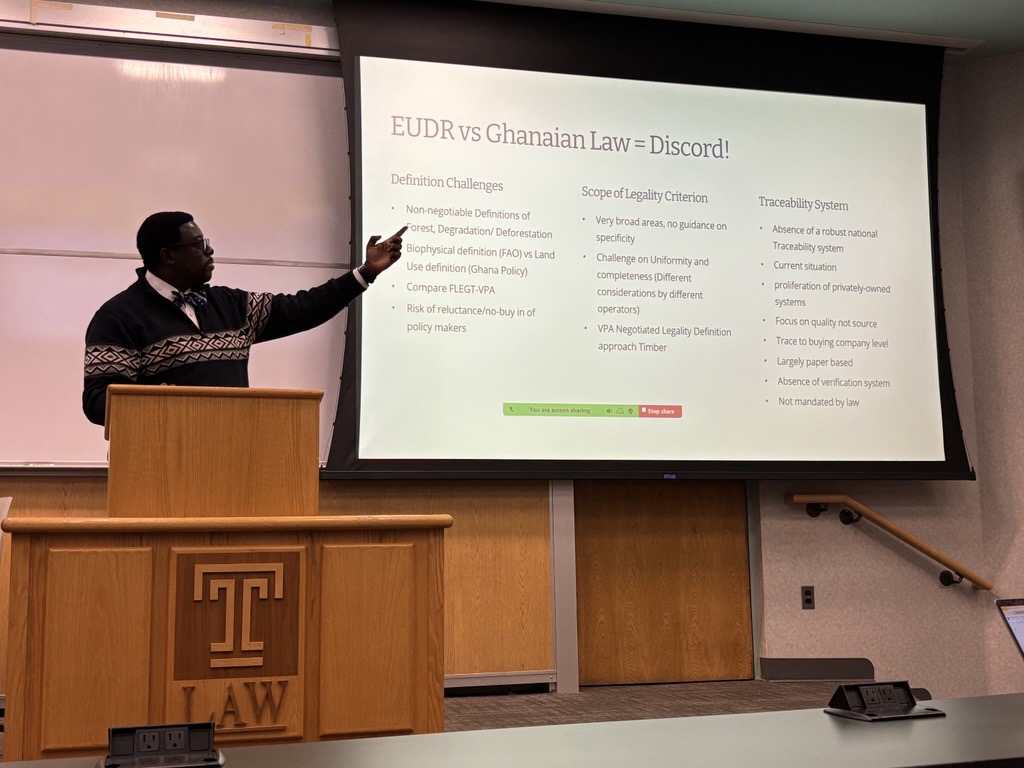
On April 9, 2025, Professor Clement Kojo Akapame, a visiting scholar from the Ghana Institute of Management and Public Administration (GIMPA), presented a lecture titled “Your Bar of Chocolate or Your Cup of Coffee May Be Causing Problems Somewhere: Deforestation & International Law” to Temple Law students. Many students from GIMPA, as well as GIMPA’s Dean Kwaku Agyeman-Budu, also attended the lecture virtually by Zoom. The lecture, organized by Temple Law School’s International Legal Society, summarized the research that Professor Akapame has been conducting for nearly the past year, since his arrival on Temple’s campus in August 2024. Professor Akapame is a legal academic and thought leader who specializes in sustainability standards for the commercial trade of forest risk commodities, as well as forestry law and policy on environmental conservation. He is also a Partner at Taylore Crabbe Barristers and Solicitors, where he leads the firm’s Corporate Commercial and Consultancy practice team. During his lecture, Akapame identified issues of deforestation due to the exploitation of cocoa bean farmers by large companies in the chocolate industry, …

Temple University Beasley School of Law's Professor Margaret deGuzman sitting on the judge of the Residual Mechanism for International Criminal Tribunals.

Are Juries Worth the Effort? A View from the International Bench

At this year’s Edward Ross Lecture in Litigation, the Honorable Rebecca Pallmeyer, Chief Judge of the United States District Court for the Northern District of Illinois, addressed the important and controversial topic: are jury trials worth the effort? Judge Pallmeyer’s answer was an unequivocal “yes.” She argued that juries are not merely useful tools for adjudicating cases, they are integral to the legitimacy of the American legal system. According to the Chief Judge, jury trials are one of the reasons that Americans respect the law. In her view, juries are often perceived as more impartial than judges, bringing diversity of experiences and perspectives to the resolution of cases. She emphasized that participation in the jury system promotes confidence in the system’s fairness.  Judge Pallmeyer’s views comport with conventional wisdom about the importance of juries. As every American knows, jury service is an essential duty of citizenship. According to a Pew Research Center Survey, two-thirds of U.S. adults consider jury service integral to good citizenship. District Court Judge Zach Zouhary begins trials by telling jurors that …

The Trump Indictment: What’s Happened and What’s Next

A New York grand jury has indicted former President Donald Trump on fraud charges, marking the first time in US history that a former or current president has faced criminal charges. Professor Lauren Ouziel, a former federal prosecutor who teaches and writes about criminal law and criminal procedure at Temple Law, explains what’s happened so far and what’s likely to happen next. Temple Law School: How do indictments work? Lauren Ouziel: A grand jury, which is a group of randomly selected people (in New York, the group is composed of 23 people), meets to hear the testimony of witnesses and review any documentary evidence. At the close of the presentation of evidence, the prosecutors will usually then present the grand jury with a proposed indictment containing the charges against the defendant. The grand jury then deliberates and considers whether there is probable cause to believe the defendant committed the crimes charged in the indictment. The grand jury then votes, and if at least 12 of the grand jurors vote in favor, the indictment is issued. …

Temple Law at Bar-Ilan University: Teaching There, Looking Back Here

Tuesday, December 27, 2022, I taught my last of 8 classes in Problems in American Criminal Law. My location? Bar-Ilan University in Ramat Gan, Israel, a suburb of Tel Aviv. This culminated a two-year journey, one interrupted by COVID and fraught with concerns about the world I would be entering, the tolerance I was hoping for, and a goal of supporting the bridge between our two law schools. The beginning of this story is simple. Bar-Ilan and Temple Law are collaborating, and as part of that process I was asked to create a course for an intersession program Bar-Ilan offers, 1- and 2-credit English-language courses for students nearing the end of the formal law school education (followed, unlike in the U.S., by a required internship before sitting for the Bar). Problems in criminal law were the focus, using the successes, failures, and dilemmas of the U.S. system as a tool to offer a comparative perspective and engender discussions about topics that know no boundaries – guns, capital punishment, race and class, the allocation of power …

More Than a Seat at the Table

More Than a Seat at the Table – Meaningful Multistakeholder Engagement yet to be Seen at UN Cybercrime Treaty Negotiations The Colonial Pipeline is one of the largest oil pipelines in the United States, spanning over 5,500 miles and supplying nearly half the fuel for the East Coast. On May 6, 2021, Eastern European hacker group DarkSide initiated a ransomware attack on the pipeline’s digital system, demanding 75 Bitcoin while holding the company’s data hostage. In response to the attack, Colonial temporarily halted all pipeline operations, causing jet fuel shortages for airlines, and leading to consumer panic buying and spiking gas prices. The Colonial Pipeline attack was not an isolated incident, ransomware attacks are rising in frequency and scope and have targeted critical infrastructure like healthcare and education systems. Information and communication technologies (ICTs) stretch across political borders, connecting societies like never before, and can increase opportunities for social and economic benefits. The COVID-19 pandemic accelerated dependence on digital infrastructure in myriad ways, facilitating drastic changes in work, education, and industry patterns. While digital connectivity …

Faculty in the Media

In the wake of a leaked Supreme Court draft opinion indicating that the historic Roe v. Wade ruling could be overturned, Temple Law faculty and staff lend their expertise to national media conversations surrounding this unprecedented development. Interim Dean Rachel Rebouché | Rolling Stone | If the leaked opinion overturning Roe becomes law, it “will have bent the moral arc of the universe backward,” writes interim Dean Rachel Rebouché and co-authors David S. Cohen and Greer Donley in Rolling Stone. Click to read. Interim Dean Rachel Rebouché | Bloomberg Law | Justice Alito’s draft opinion in Dobbs would subject laws regulating abortion to rational basis review. Interim Dean Rachel Rebouché explains what that means and how it might apply. Click to read. Interim Dean Rachel Rebouché | Washington Examiner | Returning abortion regulation to the states will invite laws that disrupt longstanding interstate cooperation, says interim Dean Rachel Rebouché. Click to read. Professor Craig Green | The Philadelphia Inquirer | Justice Alito’s draft opinion in Dobbs may have roots in his very first opinion, a …