
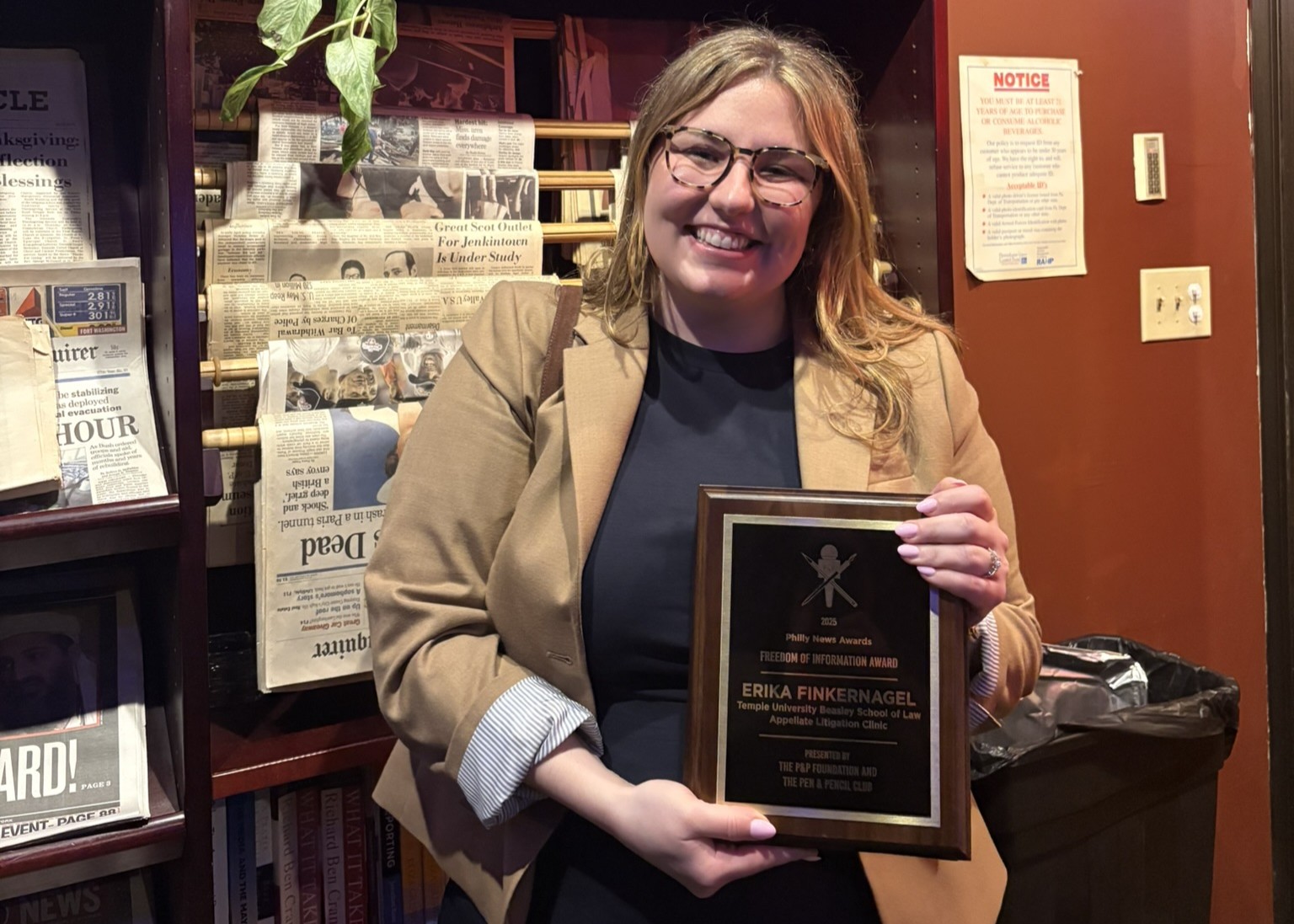
As I walked up to the podium in the courtroom, Redweld folder in hand, I thought to myself, “I hope no one here can tell that my knees are shaking.” This was my first real court appearance. As a third-year law student, I was in the Philadelphia Court of Common Pleas to argue an appeal through the Appellate Litigation Clinic at Beasley School of Law. And my very real client was watching intently from the gallery.
When I left my paralegal position before starting at Temple Law, I received valuable advice from many of my then-colleagues. One particular suggestion that I took to heart was to find a way to “stand up” in court before I graduate. That opportunity came in my final year of law school through Professor Mary Levy’s clinic. The Appellate Litigation Clinic provides high-quality legal representation to underserved communities, especially to pro se litigants who would not otherwise have counsel in appeals.
Through this program, my co-clinical students Graeme Brown, Lingxi Lu, and I had the privilege of representing a journalist in a Right-to-Know Law appeal. The Right-to-Know Law is a Pennsylvania statute, akin to the federal Freedom of Information Act. The statute empowers the public to access records from state and local agencies, and it is designed to increase transparency in government dealings.
Before our representation, a local agency denied our journalist-client’s request for records, and our client appealed this denial to the Pennsylvania Office of Open Records. When the Office of Open Records ruled in our client’s favor, the local agency appealed to the Court of Common Pleas. At this point the clinic began representing the client in responding to the appeal. Our goal was simple; ensure that the client would not be denied access to the important government records which the law intended to be public.
The clinic team met with the client, researched the relevant law and procedure, and drafted the appellee’s brief. This representation gave me practical, professional experience, not only by developing my legal writing capabilities, but also by teaching me to balance client management and court deadlines. While we were supervised by Professor Levy, the clinic is structured so that law students are responsible for their cases, clients, and deadlines. Despite still being a student, this experience gave me a small taste of being a practitioner.
When our Right-to-Know Law appeal was scheduled for Oral Argument, I was able to enter my appearance as a Certified Legal Intern. The Pennsylvania Board of Bar Examiners allows qualified law students to appear in court under a supervising attorney. I had practiced mock oral advocacy during my second year of school through Temple’s Integrated Trial Advocacy Program (ITAP). Countless students and faculty members helped me moot my argument to prepare to stand in front of a sitting judge. Then, the time came for my “stand up” opportunity. As I discovered, there is no better preparation for legal practice than to hear a judge call your case and feel a flood of nerves swell up.
My knees stopped shaking though, right in time to advocate to the court on behalf of the clinic’s client. The training I had received prepared me for this moment, and the court ultimately ruled in favor of our client. The agency provided the records as ordered, and the freedom of information prevailed.
This was an important win for the client and for journalism, as the Right-To-Know Law aims to provide the public with access to this type of information. Without pro bono representations like this one, access to justice is often denied. The clinic’s work was ultimately recognized by the Philly News Awards for the role we played in the fight for freedom of information.
As for me, I will proudly call myself a Temple Made lawyer upon graduating this Spring, thanks to my experience in the Appellate Litigation Clinic and thanks to the brilliant clinical and advocacy faculty at the law school.
