
As I write this, sitting in my childhood living room in Dorado, Puerto Rico, I’ve already lost power twice. In Puerto Rico, a daily power outage or two is the norm. Our island’s energy system is infected with a culture and expectation of impropriety. Puerto Rico’s energy infrastructure is constantly damaged by natural disasters, and the island’s ability to recover, rebuild, and improve is perpetually hampered by colonial policies. Despite our island’s abundant renewable energy sources, we have been forced to rely on fossil fuels.
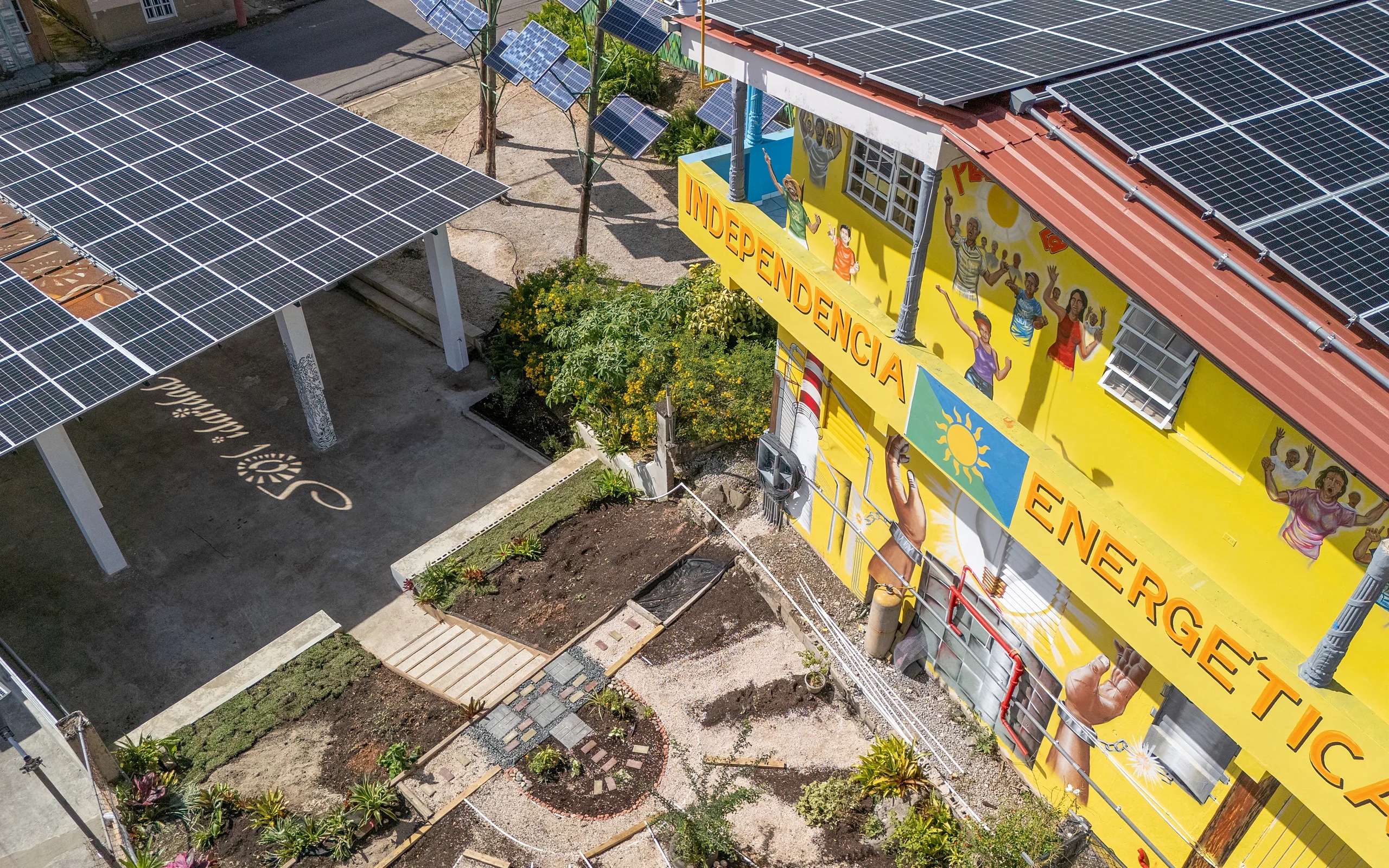
But communities in Puerto Rico are taking climate action into their own hands. Casa Pueblo is Puerto Rico’s first community-operated solar microgrid. It’s leveraging Puerto Rico’s solar capacity to ensure the surrounding town has a reliable source of electricity, especially during crises. Casa Pueblo is not just a symbol of, or model for, Puerto Rican energy revolution, it embodies a larger movement of decolonizing energy and decolonizing Puerto Rico.
Solar energy and community activism are Puerto Rico’s greatest resources, but the island can’t succeed on its own. In the face of increasing climate disasters, poor local governance, and federal colonialist laws, Puerto Rico’s communities need direct resources and support to facilitate the island’s successful transition away from fossil fuel reliance.
Puerto Rico’s Decrepit Energy System Has Failed Its Residents
Puerto Rico does not produce its own fossil fuels. It has renewable resources like solar, wind, hydropower, and biomass, but it heavily relies on imported fossil fuels to meet its energy needs. In 2022, fossil fuel power plants generated 93% of Puerto Rico’s electricity. More specifically, petroleum power plants provided a majority of that electricity (63%), followed by natural gas (23%), coal (8%), and renewables (6%). Compare this with the 50 US states (except Hawaii and Alaska), where less than 1% of their electricity is generated with petroleum. This heavy reliance on petroleum means that Puerto Rico’s power prices fluctuate with international petroleum prices. In 2022, Puerto Rico’s average electricity price was higher than the average energy price in 49 states.
A Poorly Designed Electricity System
In addition to its unsustainable sources of power and high cost, Puerto Rico’s electric power system has suffered from decades of poor planning and management. The Puerto Rican Power Authority (PREPA) was founded in the 1920s. In 1970, PREPA established the first major power plant in Puerto Rico. From the beginning, the plant and its distribution system were disastrous. The plant was built near the facilities of the oil industry on the island’s southern coast. However, 70% of Puerto Rico’s population lives in the north side of the island. From its inception, this design flaw has caused significant disruptions to the transmission of energy from this power plant to the rest of the island.
A Weak Electricity Grid Made Weaker by Natural Disasters
Natural disasters have exposed major weaknesses of this design. In 2017, Hurricanes Irma and Maria made landfall in Puerto Rico and destroyed much of the island’s electricity transmission and distribution infrastructure. Though the actual power plants in the southern part of the island were undamaged, the vast network of transmission and distribution lines was severely damaged. As a result, millions of Puerto Ricans lived in complete darkness for nearly a year, making it the longest single blackout in US history. This blackout was not just inconvenient, it created life or death situations for thousands of people. The prolonged power outage and poor emergency response led to the deaths of more than 3,000 Puerto Ricans who experienced significant interruptions in access to medical care. Three years later, while Puerto Ricans were still recovering and mourning losses from the previous hurricane, the island was hit by another catastrophic weather event: a 6.4 magnitude earthquake. This earthquake significantly damaged the island’s two largest power plants. And again, Puerto Ricans were left in total darkness for months.
An Electricity System Strangled by Colonialism
The island’s forced reliance on fossil fuels is a deadly form of colonial control that conveniently ignores the island’s existing, abundant renewable energy potential. In 1912, Congress passed the Jones Act which granted Puerto Ricans US citizenship. It also established that any bonds issued by the Puerto Rican government would be free from the taxes with which such bonds are normally burdened (on their interest and on their growth when sold). Additionally, as a condition of the ratification of Puerto Rico’s constitution in 1952, it was written into the island’s constitution that public debt repayment must take priority over financing public services. The combination of tax breaks and constitutional protections made these bonds extremely attractive to investors. By 2015, Puerto Rico had amassed over $72 billion in debt obligations. Nearly $9 billion were PREPA’s debt.
However, Puerto Rico is not entitled to the same financial protections awarded to the states. Under Chapter 9 of the federal Bankruptcy Code, US states can declare bankruptcy and restructure their debts. But not Puerto Rico. The Code explicitly excludes the island from Chapter 9’s protections. In response to Puerto Rico’s crippling debt, Congress passed, and former President Obama signed, the Puerto Rico Oversight, Management, and Economic Stability Act (PROMESA, meaning promise). Instead of amending the Bankruptcy Code to allow Puerto Rico to restructure its debt, PROMESA established a Financial Oversight and Management Board (locally known as La Junta), whose members were not elected by Puerto Ricans but were appointed by the President. La Junta was given responsibility for all major fiscal decisions. Its authority superseded Puerto Rico’s government, completely sidelining local officials. After multiple failed negotiations with creditors to repay Puerto Rico’s debts, La Junta implemented a series of spending cuts targeting the compensation of public sector employees and retirees, reducing public services, and privatizing public utilities.
PREPA was the first to go. In 2020, La Junta selected LUMA Energy, a group of private North American companies, to take over Puerto Rico’s electricity transmission and distribution system. On top of that, the island was also forced to sell off its major power plants to Genera, a New York-based natural gas company that manages contracts to purchase gas for itself. La Junta claimed privatization would solve Puerto Rico’s energy and debt crises. But these claims were all just empty promises. Today, Puerto Ricans pay more than double the US average electricity rate. Yet, Puerto Ricans have the least reliable electrical system in the US. Blackouts and power outages are daily occurrences, even on the most beautiful, sunny days.
At the federal level, the Inflation Reduction Act (IRA) made tax credits available to individuals, families, and businesses to lower the cost of installing or renovating renewable energy systems(at least until the “One, Big, Beautiful Bill Act” rescinded those credits last summer). But even during the years when these tax credits were available, Puerto Rico’s residents were not entitledto them. Only tax-exempt non-profit organizations in Puerto Rico could receive them. The IRA made millions of dollars available to Puerto Rico to expand renewable energy on the island. But unlike tax credit recipients in the US, individual Puerto Ricans did not directly reap those benefits. Those dollars went instead to Puerto Rico’s government, which was (and is) ultimately controlled by La Junta: the entity that sold off Puerto Rico’s power plants and distribution network to private companies.
Most recently, on February 9, 2025 Genera signed a $767 million dollar contract to acquire 430 megawatts of Tesla Megapacks. These megapacks (expected to be fully operational by 2027) will store energy from the island’s existing fossil fuel plants and improve the “reliability of the island’s electrical system.” This is only a small step towards building a more dependable energy system; this project does nothing to lower electricity costs for Puerto Ricans or ensure a transition to renewable sources. In fact, it may incentivize continued reliance on fossil fuels as electricity generation and transmission becomes more “reliable.”
In the meantime, local communities are stepping up and adopting renewable energy solutions that not only provide reliable electricity to their residents, but that have also inspired a movement for energy independence in Puerto Rico.
Casa Pueblo: A Case Study for Successful Community Activism and Energy Freedom
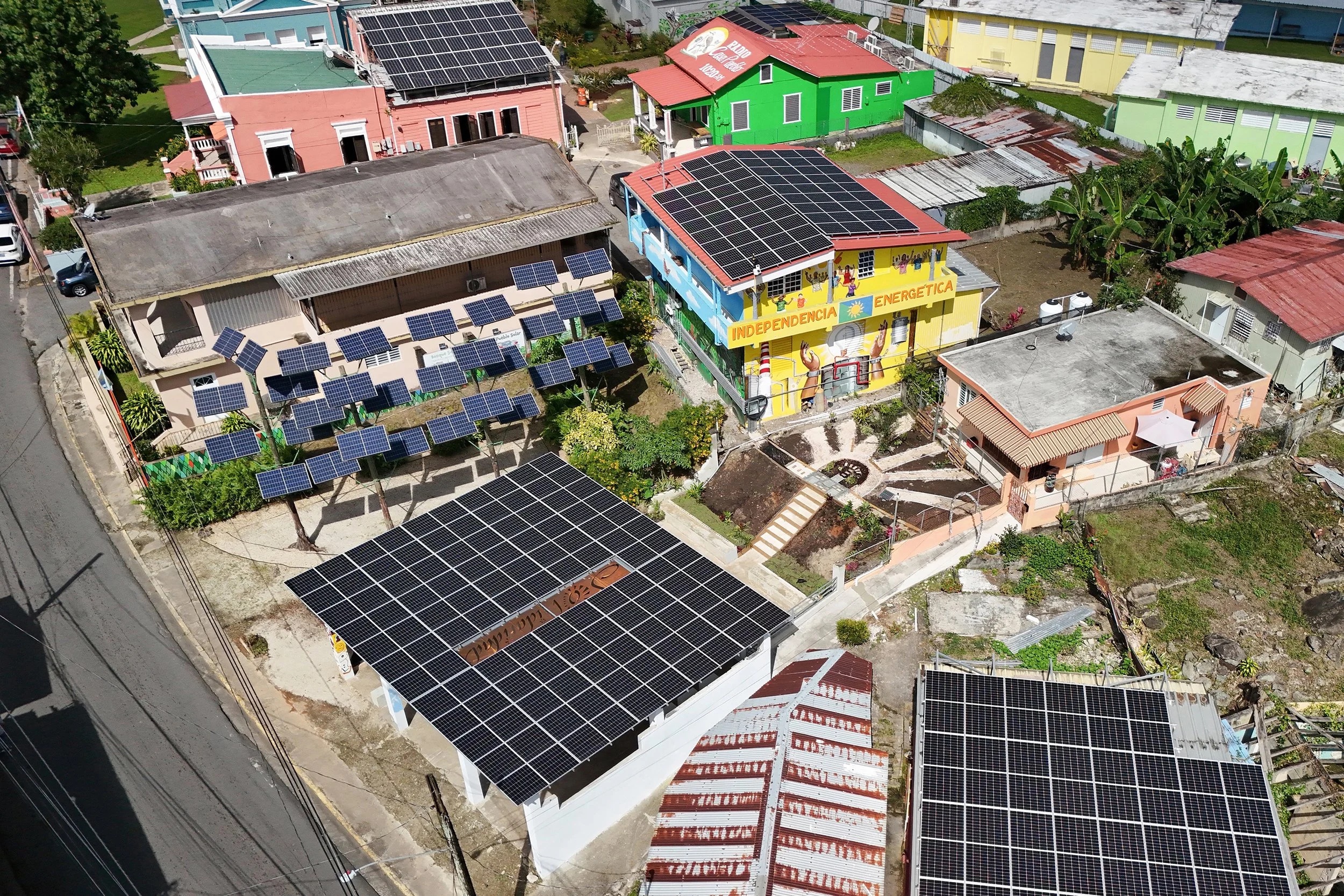
In response to a proposed open pit mine in their hometown of Adjuntas, Puerto Rico, residents rallied against the mine and the devastation it would bring to their community. Casa Pueblo emerged from this resistance and grew into a hub of environmental advocacy, education, and activism. Housed in a small building in the historic town of Adjuntas, Casa Pueblo has been completely run on solar energy since 1999. In 2017, Hurricane María left most residents of Adjuntas without electricity for almost a year. In a time of literal darkness, Casa Pueblo opened its doors to the community and became a lifeline for residents who needed electricity to refrigerate medication and receive medical treatment.
In 2019, Casa Pueblo and neighboring businesses began fundraising to expand the town’s solar energy capacity. In collaboration with private non-profit organizations, the town created Puerto Rico’s first cooperatively managed solar microgrid—a network of photovoltaic panels and battery storage units. The microgrid includes 700 solar panels mounted on seven buildings in Adjuntas’ central plaza and a battery storage system that can provide enough off-grid electricity to keep 14 local businesses running for up to 10 days. The microgrid is run by the Community Solar Energy Association of Adjuntas. The Association sells electricity to Puerto Rico’s main electricity company through a power purchase agreement. The money the Association saves by not buying electricity from the main power company supports the maintenance of the microgrid.
Solar Energy as a Tool for Decolonization
But this microgrid is not just about having electricity in times of need; it’s part of a movement that seeks to liberate the island from energy colonialism. Since the inauguration of the microgrid, residents of Adjuntas and other environmental activists have gathered every year for La Marcha del Sol (The Sun March) to advocate for a renewable energy transformation in Puerto Rico.
Federal laws, the privatization of the electricity system, and local mismanagement have forced Puerto Rico’s dependence on fossil fuels that conveniently ignores the island’s existing, abundant renewable energy potential. Because the island receives so much sunlight, Puerto Rico could produce over four times the amount of energy it needs just from rooftop solar power. Even without systematic changes to support the transition to solar energy, Puerto Rico ranks higher than 40 US states in terms of per-capita home solar installation. And not surprisingly, most of this residential installation is accomplished by community groups such as Casa Pueblo. In the past few years, Casa Pueblo has helped install solar energy systems in more than 100 homes and over 30 businesses in Adjuntas. One by one, these homes and communities are taking ownership of their electricity and their lives.
Puerto Rico’s energy crisis is the product of colonial power, systemic mismanagement, and natural disasters. Left to fend for themselves, the people of Puerto Rico are taking climate action into their own hands. Community initiatives like Casa Pueblo are inspirations for energy sustainability and autonomy. But communities can’t do it alone. Puerto Rico’s transition to renewable energy requires dismantling colonial systems and practices that have forced the island’s dependence on fossil fuels and prevented it from maximizing its solar energy potential. In the meantime, Casa Pueblo will continue to be a beacon of hope for Puerto Ricans—hope for a future with reliable electricity that saves lives and protects our planet.
