
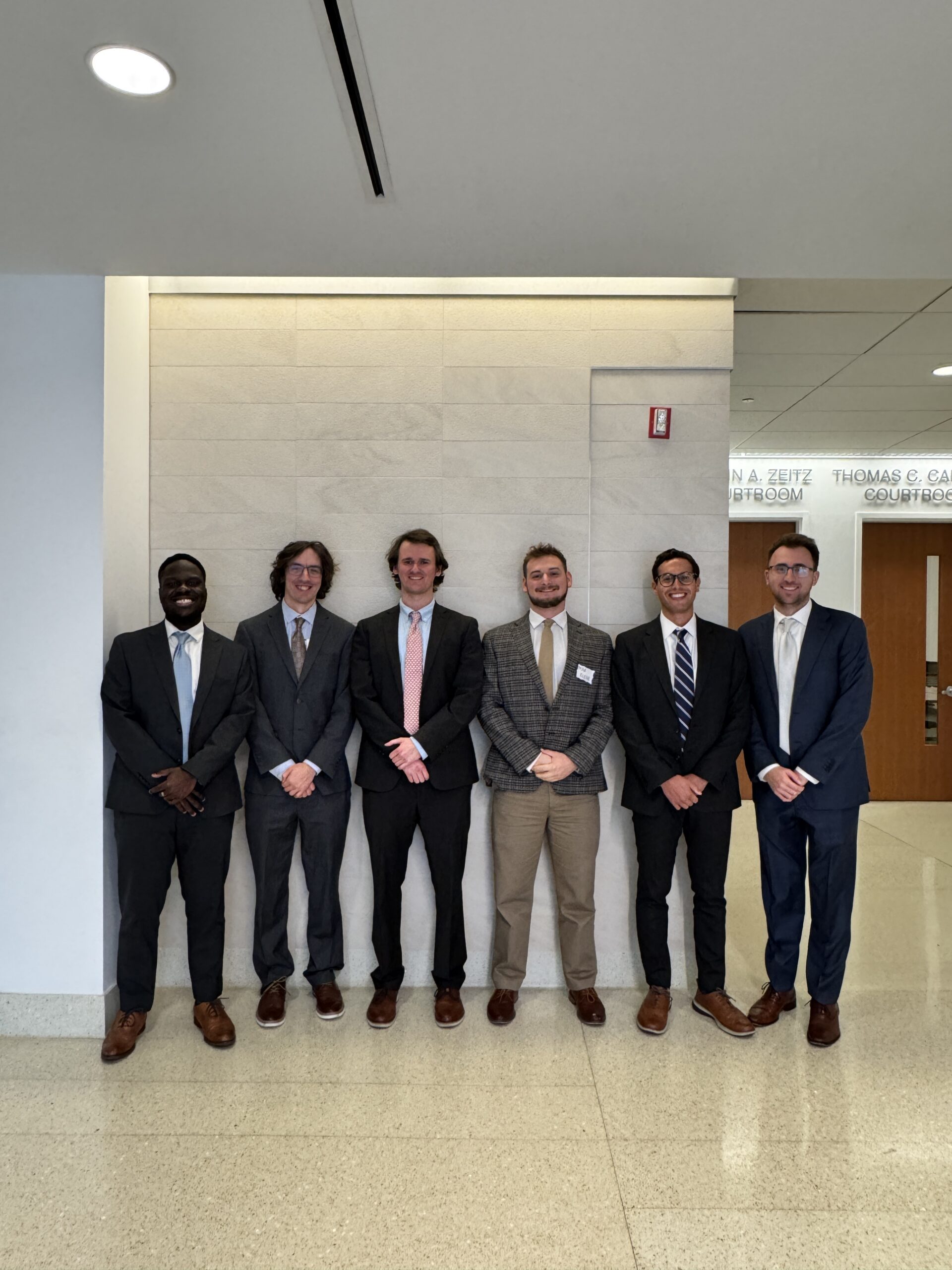
Temple Law’s Sports Law Negotiation Team recently sent two teams to the fourth annual Villanova Baseball Filing Day Competition. Both teams succeeded in advancing to the second day of the competition, finishing as quarter finalists.
The Villanova Baseball Filing Day Competition is a simulated negotiation tournament in which law students have the opportunity to represent Major League Baseball teams and players in pre-arbitration contract negotiations. A player is eligible for arbitration when they have accrued between three and six years of major league service. They are still under contract with their club, however their salary is not fixed and they are able to negotiate a raise based on their performance on the field. The two sides have until MLB Filing Day to reach a one-year settlement or agree to a multi-year extension. If a deal cannot be reached, they proceed to arbitration. Arbitration is risky for both parties because a judge listens to their cases and chooses one of their proposed salaries–there is no in-between. Thus, both the player and their club are motivated to settle. This competition simulates MLB Filing Day: there is one hour until the deadline and the parties are scrambling to agree to a deal.
Baseball contract negotiations are driven by statistics, particular those of the player’s platform year – the most recent season. Each side compares the player’s statistics to those of other players who play the same position and were eligible for arbitration in prior seasons, and uses those comparisons to support a proposed salary. In addition, they identify market drivers – the statistics that they believe are the most important in determining player compensation.
For example, at this year’s competition Temple students were tasked with representing the Seattle Mariners against starting pitcher George Kirby. Temple identified earned run average (“ERA”) as the market driver for starting pitchers and compared Kirby’s 4.18 ERA in his 2025 platform season to Ranger Suarez’s 4.21 ERA in 2023. Thus, Temple believed Kirby was due a raise of $2.1 million, mirroring that of Suarez. The opposing team believed fielding independent pitching (“FIP”) was the market driver for starting pitchers, and compared Kirby’s 3.37 FIP in 2025 to Max Fried’s 3.31 FIP in 2021 to justify a raise of $3.35 million. Negotiations proceedfrom there, with each side presenting various player comparisons to support their proposed salary and attempting to poke holes in the opposition’s arguments. They slowly move towards a middle ground in an effort to avoid arbitration, though ultimately a deal cannot always be reached.
Competing in the Villanova Baseball Filing Day Competition was an incredible opportunity for Temple students to hone their negotiation skills and gain experience outside of the classroom. Competitors received invaluable feedback from the judges, experienced professionals in the baseball industry including player agents and members of MLB teams’ baseball operations departments. The judges gave pointers on how to craft effective arguments and provided excellent insight into real baseball contract negotiations. The Sports Law Negotiation Team eagerly awaits the opportunity to apply their guidance at their next tournament, Tulane’s International Baseball Arbitration Competition in January.
